The zeros of the Riemann zeta function
Zeta zeros
The zeta function ζ(s) = 1 + 2−s + 3−s + …, defined for Re(s) > 1 and continued to the whole plane, vanishes at two kinds of point. The trivial zeros sit at −2, −4, −6, … . The nontrivial zeros sit inside the critical strip 0 < Re(s) < 1, and every one ever computed lies on the critical line Re(s) = 1/2. They control the primes, and they repel each other like random-matrix eigenvalues.
Figure 1 Settled

What the zeros are
- Settled Trivial zeros at the negative even integers come from the gamma factor in the functional equation ξ(s) = ξ(1 − s).
- Settled Nontrivial zeros lie in the critical strip, come in conjugate pairs, are symmetric under s ↦ 1 − s, and are infinite in number: about (T/2π) log(T/2πe) of them up to height T.
- Settled Every zero up to height 3·1012 is on the critical line (Platt–Trudgian 2021), and infinitely many are on it (Hardy 1914).
- Open The Riemann Hypothesis, posed by Riemann in 1859, says all of them are. It is one conjecture about the zeros, not the name of this site.
Why they matter
Each zero is a frequency in the primes. The explicit formula writes the prime-counting staircase as a smooth term minus one wave per zero, so where the zeros sit decides how far the primes stray from li(x). Their spacings follow the statistics of random Hermitian matrices, which links number theory to quantum chaos.
Site map: the reading path
Read in order, or jump in. Every page ends with previous and next links along this path. The status of every claim, at a glance, is on the Riemann Hypothesis page.
Primer
The zeros
- 2Zeros on the critical lineProven + computedWhere the zeros sit: the strip, |ζ|, Hardy’s Z(t), Gram points, counting N(T) and S(T).
- ↳How much of the critical line can we prove?Known + computedHardy, Selberg and Levinson: how a share of the zeros is proved to lie on the line, with the ladder up to 41.7% and small-height checks.
- ↳The critical line in quaternions and octonionsKnown + checked project explorationZero spheres, folding, linking, collisions, and a real point-versus-sphere experiment.
- ↳What bigger spaces can tell the number lineKnown + checked transfer ledgerActual bridges, solved geometric analogues, and what does not follow from more dimensions.
- 3Statistics of the zerosComputed · conjecture testedHow the zeros are spaced: GUE spacings at three heights, pair correlation, number variance.
Zeros and primes
The Hypothesis
- 5The Riemann Hypothesis: one conjecture about the zerosOpenOne conjecture about the zeros: status at a glance, what is proven, what is not.
- 5·Lifting a dimension: when it forces zeros onto the linePrimerMonge’s circles, Weil’s proof for curves over finite fields, why it does not reach ζ, and the octonion plane that cannot be lifted.
- ↳Foliations, singular points, and Deninger’s pictureKnown + proposed, not a proofWhat a foliation is, zeros of a vector field, and Deninger’s dictionary between closed orbits and primes. The space for ζ has not been constructed.
Reference
Gallery: the zeros, computed
Fifty-two figures from real computation or Odlyzko’s published tables. Each opens the full figure with its data-provenance caption.
Primer 7 figures


The zeros 17 figures


Zeros and primes 8 figures
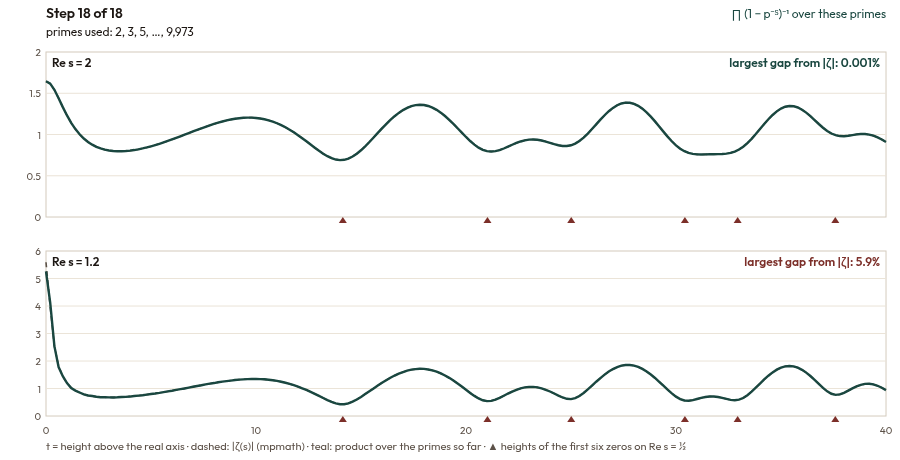


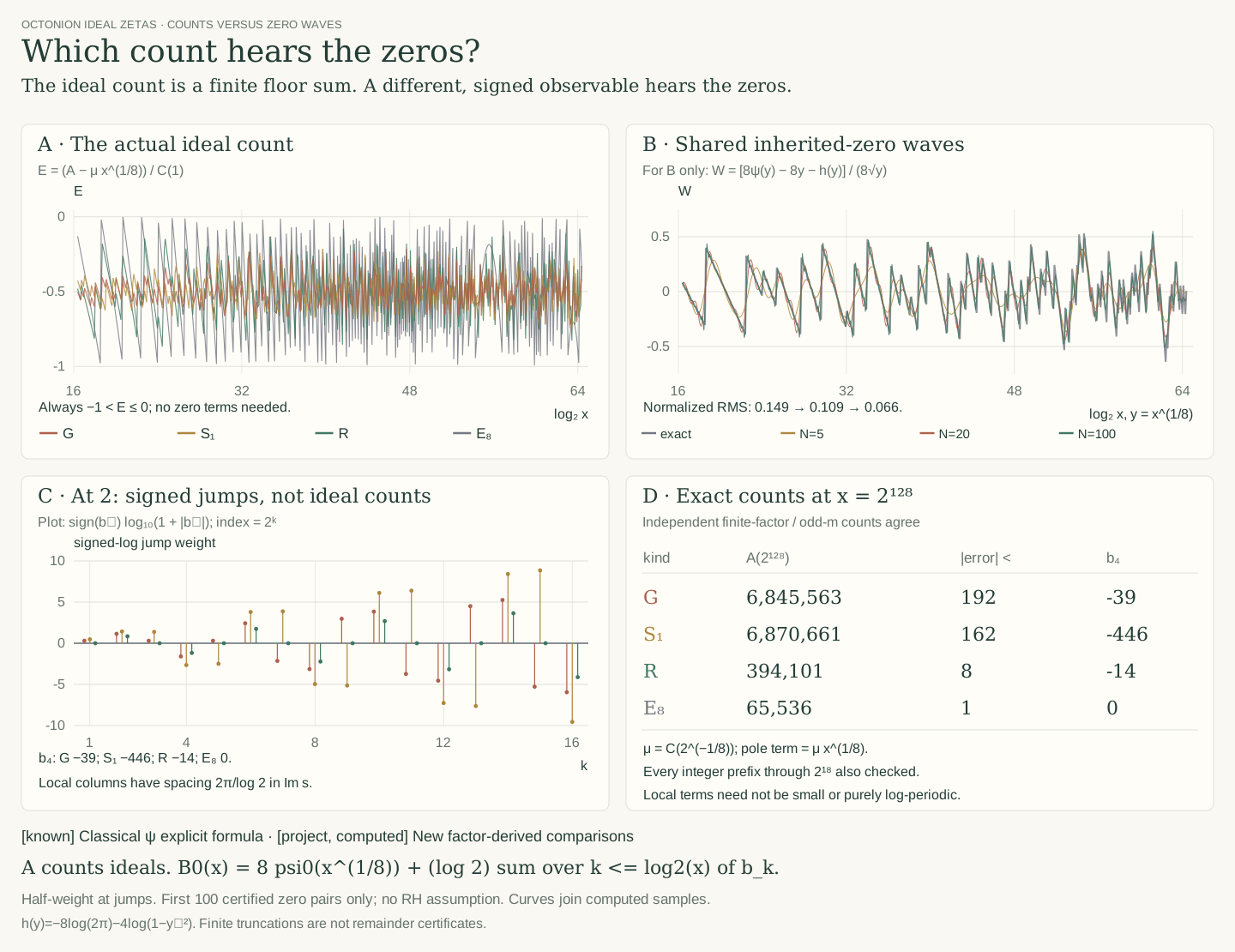


The Hypothesis 20 figures


Reading path · step 1 of 13