A checked exploration · beyond the complex plane
The critical line in quaternions and octonions
RH asks whether every nontrivial zero of ordinary zeta has real part ½. Extra imaginary directions turn its complex zero pairs into spheres. Counting ideals is a different construction: it changes the function and its zero families.
[project] First separate the constructions. Turning the imaginary direction enlarges ordinary zeta’s zero picture. Counting ideals changes the function itself. A mirror pairs zeros; it need not put them all on its midpoint.
Labels: [known] sourced mathematics; [project] checked here, not a novelty claim; [speculative] unproved. Read the tag key. Project referee passes are not outside peer review. No RH claim.
1 · Complex zeros become quaternion spheres
[project] Write a complex input as s=σ+it: σ is the horizontal real coordinate, and t is the vertical imaginary height. The critical line is σ=½. First we keep ordinary zeta and let its imaginary direction vary: this is the intrinsic, real-coefficient slice lift, not a new arithmetic function.
More imaginary directions: the intrinsic construction
[known] An imaginary unit is a direction that squares to −1. Complex numbers have two choices, i and −i. Quaternions have a whole ordinary sphere of choices, mixing i, j and k. Octonions have a six-dimensional sphere of choices, mixing seven imaginary coordinates. “Six-dimensional sphere” means its surface has six independent directions; it sits in seven imaginary dimensions.
Figure 1

[known] Write a number as q = x + rI: real part x, imaginary size r, chosen imaginary direction I. Each fixed I gives an ordinary complex plane inside the larger space. Zeta has real coefficients, so it treats every I alike. To evaluate it, calculate ζ(x + ir) = A + iB in the complex plane and replace i by I:
[project] This is an exact reduction, not an approximation. In particular, |ζ(x + rI)| = |ζ(x + ir)|. Turning the imaginary direction cannot change the size of the value or reveal a previously hidden zeta zero. This is slice analysis, not a claim that zeta satisfies every other definition of quaternionic analyticity.
Where ½ and the zeros go
[known] In the complex plane, Re q = ½ is a line. In quaternion space it is a three-dimensional flat hyperplane, and in octonion space it is seven-dimensional. A hyperplane is simply the flat set left after fixing one coordinate. A conjugate pair of complex zeros, a ± ir, becomes the whole sphere a + rS² or a + rS⁶. The trivial zeros, −2, −4, −6, …, stay single points on the real axis.
[known] For the clean mirror, use completed xi, which removes zeta’s pole and trivial zeros. Its mirror law is ξ(1 − q̄) = ξ(q)̄: reflect the input through that hyperplane, and the output is conjugated. On Re q = ½ the input is fixed by that mirror, so ξ’s value must be real. Uncompleted zeta is not generally real there.
[project] RH now says: every nontrivial zero sphere has its centre at ½ on the real axis. Off-line zeros would produce two mirror spheres, centred at a and 1 − a. The extra directions make the picture larger, but do not tighten the condition. Every real number is central in these algebras; ½ is special here because of the functional equation, not because other real numbers lack that property.
[project · checked] We sampled the first three zeta spheres in 12 directions each, in both algebras. The largest numerical zero residual was 4.22 × 10−60. Xi’s unwanted imaginary part on sampled critical spheres stayed below 3.22 × 10−62. These share underlying complex evaluations; they check the construction, not RH beyond those examples.
Figure 2
One conjugate pair, a whole sphere
Turn the imaginary direction u. The zero does not acquire a new real part or a new radius.
All unit directions form S²; the dot is one sample.
Static summary. Motion controls appear when JavaScript is available.
2 · Quaternion arithmetic: when the mirror forces a zero
[known] There is established arithmetic where quaternionic symmetry really does change the answer at the central point. The quaternion group Q₈ = {±1, ±i, ±j, ±k} can describe the Galois symmetries of a number field. Its Artin L-functions encode how primes act through those symmetries. This is not ordinary zeta evaluated at a quaternion; it is a different, genuinely nonabelian arithmetic L-function.
[known] Its two-dimensional quaternionic representation can produce a completed L-function with root number −1. A root number is the sign in its mirror equation. With that sign, the value at the central point is forced to be zero:
At s = ½: Λ(½) = −Λ(½), so Λ(½) = 0.
Figure 3

[known/project] Q₈’s relevant matrices preserve a skew form, and their Frobenius–Schur indicator is −1; we checked those representation facts directly. Artin Euler factors use matrix determinants, so they remain well-defined scalar factors rather than contradictory unordered products of i and j. In the corresponding field-zeta factorization, the two-dimensional Artin factor is squared: a forced central Artin zero supplies at least a double field-zeta zero.
The tiny sign change changes which outputs are allowed
[project · exact deduction] With zeta’s plus-sign mirror, a fixed critical input has a real xi value. With the minus-sign mirror and real coefficients, a fixed critical input must instead have a purely imaginary completed L-value. At the real centre ½, the value would have to be both real and purely imaginary: it is forced to be zero.
Minus mirror: it can map to a whole imaginary output sphere.
Figure 4

[project · checked models] The simple models cosh(q − ½) and sinh(q − ½) show the contrast exactly. At q = ½ + rI, their outputs are cos r and I sin r. For r = .7, the first stays the real number .764842…; the second has size .644218… and turns with I. These are symmetry models, not numerical Artin L-values. They show why the full-Jacobian collapse discussed for xi is not automatic for every mirror-symmetric L-function.
[project, interval certificates] For the three named Artin examples, the later height-100 work isolates 179, 180 and 224 positive zeros, matching independent Turing counts. The two negative-sign centres are simple. These are finite checks of those functions, not a general theorem. Height-100 record · Turing-count method.
Artin examples: values, twist checks and earlier certificates
Now checked: explicit fields, different answers
[project · computed] We now have actual Artin L-values, not just a symmetry sketch. Two explicitly identified fields have the same eight-element quaternion group and the same conductor, 2304—a measure of their arithmetic complexity. Yet one has mirror sign −1 and a forced central zero; the other has sign +1 and a nonzero centre. Quaternionic symmetry makes this possible, but does not choose the sign by itself.
Figure 5

| LMFDB representation | Conductor | Mirror sign | L(½) |
|---|---|---|---|
| 2.2304.8t5.b.a | 2304 | −1 | 0 exactly, forced by the mirror |
| 2.2304.8t5.a.a | 2304 | +1 | .708769134170846566… |
| 2.42025.8t5.a.a Magma’s classic example | 42025 | −1 | 0 exactly, forced by the mirror |
[known / project checked] We also reproduced the Magma handbook’s classic Armitage example, the third row. Its degree-eight polynomial reduces exactly to LMFDB’s polynomial, its field discriminant is 205⁶ = 74220378765625, and its mirror sign is independently interval-certified as −1. At 100 digits, its central evaluation prints 0.E-117, with computed slope 1.6521867961736896…. This field is totally real, like the positive comparison: the negative sign is not just a distinction between real and imaginary fields.
[known / project checked] The linked primary database records give both signs. We independently checked each exact field, its full quaternion group and its two-dimensional character. Then we certified the signs with interval arithmetic: build a rapidly decaying sum from 1000 exact prime-derived coefficients for the first pair, or 3000 for the classic example, bound everything left out, and check its sign at two matching inputs. One example gives opposite signs; the other gives matching signs. The detailed proof and reproducible certificate are below.
[project · checked] Separate 40-, 70- and 100-digit runs recover both signs without supplying them in advance. At 100 digits, PARI prints the negative example’s central value as 0.E-115. That is numerical-zero notation, not a new measured error bound: the exact zero follows from the certified minus sign. Its computed slope is L′(½) = 3.402903132809379…; the positive comparison remains .708769134170846… at the centre. The plots and long decimal slopes are high-precision numerics. The independent interval bounds below now prove that both negative-sign central zeros are simple.
The exact fields and what was certified
[project · exact arithmetic] The negative example is the degree-eight field defined by x⁸ + 12x⁶ + 36x⁴ + 36x² + 9 = 0, LMFDB field 8.0.12230590464.1. The positive comparison uses x⁸ − 12x⁶ + 36x⁴ − 36x² + 9 = 0, field 8.8.12230590464.1. Both discriminants are 12230590464. Exact Galois calculations identify Q₈; Arb ball arithmetic and an explicit infinite-tail bound certify the two root-number signs. This is a reproducible computation with a written proof, not a machine-checked formal proof.
[project · reproducible] Full field, sign-certificate and L-value notebook · Interval certificate · Numerical results and plot samples · PARI checking script · Independent interval-sign script.
[project · actual Artin values] We can now see that contrast without a toy. For the negative-sign example, Λ(½ + .1j) ≈ .6298337094j, while Λ(½ + .1k) ≈ .6298337094k. Those are different numbers of equal size. Its whole critical input sphere becomes an imaginary output sphere. The positive comparison instead gives the same real value, about 36.05892230, in every direction. The same intrinsic construction works in octonions. The small change in the mirror sign really changes the allowed outputs.
Not every “quaternion zeta” vanishes at ½
[known] There is another arithmetic construction that counts ideals in a quaternion order—the analogue of integers inside a quaternion algebra. It is not the Artin L-function above. For the Hamilton algebra’s Hurwitz maximal order, Voight gives the factorization
At s = ½: ζB(½) = −log(2)/2 ≈ −.3465735903, not zero.
[known / project checked] A factor tending to zero cancels zeta’s pole; taking the analytic limit leaves a finite nonzero number. We checked that limit from both sides. This is a useful warning: the function being counted, its normalization and its mirror law all matter. The known source is Voight’s Quaternion Algebras, Theorem 26.4.9 and §26.8. The extra field certificate and Hurwitz-limit results are downloadable, with their checking script.
Three further checks: slope, twists and actual zero spheres
The two central zeros are now proved simple
[project · interval certified] Earlier, a nonzero numerical slope suggested that each forced central zero was a single crossing rather than a flatter, repeated zero. We have now enclosed the whole derivative in rigorous intervals:
Classic conductor 42025, sign −1: 1.62 < L′(½) < 1.69.
[project · proved for these examples] Neither interval touches zero. Together with the already certified mirror signs, that proves each central zero has multiplicity exactly one. The proof bounds an integral made from exact prime-derived coefficients, using Arb interval arithmetic and explicit bounds on both infinite tails. It does not take the previously computed slopes as inputs. The two quaternionic central zeros are therefore isolated regular points, with local degree +1—not positive-radius zero spheres.
[project · scope] This is an auditable computational proof for two explicit arithmetic functions, not a proof that every quaternionic Artin central zero is simple. The integral derivation and tail proof, certificate script and complete derivative enclosures are available.
Change the arithmetic, keep the sign—with a condition
[known] A quadratic twist changes the weights attached to primes using a quadratic character. It is not a rotation from i toward j. Shankar–Södergren–Templier’s Proposition 8.7 proves that admissible Q₈ twists preserve the root sign. Here “admissible” means a fundamental quadratic discriminant D, coprime to the field discriminant. That coprimality condition matters.
[project · checked] We tested six such positive discriminants on each of our three bases: 18 twists. Every one kept its base sign. We checked exact initial coefficients, the new conductor N × D², and the functional equation, starting with the sign marked unknown. The two conductor-2304 bases retain −1 and +1 respectively; the classic conductor-42025 base retains −1.
| D | New conductor, N = 2304 | Signs of the two bases | New conductor, N = 42025 | Sign |
|---|---|---|---|---|
| 13 | 389376 | −1 / +1 | 7102225 | −1 |
| 17 | 665856 | −1 / +1 | 12145225 | −1 |
| 29 | 1937664 | −1 / +1 | 35343025 | −1 |
| 37 | 3154176 | −1 / +1 | 57532225 | −1 |
| 53 | 6471936 | −1 / +1 | 118048225 | −1 |
| 61 | 8573184 | −1 / +1 | 156375025 | −1 |
[project · important control] The D=−4 comparison shares the ramified prime 2 and lies outside the coprime theorem, so its changed sign is no contradiction. The original table covers positive D only. Later negative-D computations and twelve derivative certificates are recorded separately; the earlier software limitation is no longer the project’s current status. Negative-twist update.
Twist the arithmetic twelve times: the forced zero stays simple
[known] Each negative-sign twist still has a forced central zero. The minus mirror makes its central multiplicity odd; it could be three or higher, rather than one. A nonzero certified derivative is what proves simplicity.
[project · interval proof] We enclosed the slope L′(½) of all twelve sign −1 twists (D = 13, 17, 29, 37, 53, 61 on both negative bases). Every slope lies between about 4.0 and 13.8, with error bars below 10−10. None is zero, so every forced central zero is simple: a single crossing, which in quaternion space is one real point rather than a sphere. The same script reproduces the two base slopes proved earlier.
Figure 6

[project · reproducible] Method, table and caveats · Certificate script · All fourteen enclosures and error bounds
Real quaternion coefficients: the length is arithmetic, the direction is not
[known] In a field whose symmetry group is Q₈ = {±1, ±i, ±j, ±k}, the prime-by-prime symmetries (Frobenius elements) are literally quaternions. But each one is only defined up to a swap like i ↔ −i, because it depends on which prime “upstairs” you look at. That is why Artin’s formula uses a determinant, which ignores the swap.
[project · exact proof and checks] So try the naive thing: multiply the quaternion factors (1 − gpp−s)−1 in order, for real s > 1. Because the length of a product of quaternions is the product of the lengths, the squared length always comes out to exactly the Artin L-value, whatever order and whichever signs you choose. With exact fractions for primes below 200, six different choices give six different quaternions with the identical exact length.
Figure 7

[project · interpretation] The extra directions are real, but they record our arbitrary choices, not arithmetic. This is a precise version of the earlier toy warning: noncommuting coefficients give more data, and only the length is canonical.
[project · reproducible] Proof, numbers and limits · Checking script · All results
Complex s: where the complex i lives matters
[project] The section above used real s. For complex s = σ + ti, the factor p−s needs an imaginary unit, and there are two honest places to put it. If that i is one of the quaternion directions, the quaternion norm only sees how much each prime’s Frobenius direction points along it. One quadratic subfield is singled out, primes pointing elsewhere stop oscillating, and the product depends on arbitrary sign choices. In the conductor-42025 field those choices change its size by up to about 4.7 times (1.54 in natural log).
[project] If i is kept separate, commuting with the quaternions, each factor becomes a 2×2 complex matrix. Then the product’s determinant is exactly the Artin L-function for every choice and order of the factors. The determinant is the only choice-free quantity we found; the trace still depends on the choices. Everything here is in Re s > 1 (σ = 2 and 3/2), where the product converges; no zeros are involved.
Figure 8

This is groundwork for Artin L-functions, which are members of the zeta family; it is not a result about where zeros lie. Closed form, numbers and limits · checking script · run log
Half an L-function: what the aligned product really is
[project] In plain words. Above, putting the complex unit inside the quaternions made the product keep only one factor for each prime that splits in one particular quadratic field, where Artin’s L-function has two. That “half” product turns out to be, almost exactly, a square root of the Artin L-function, times two small correction factors made from ordinary Dirichlet L-functions. So nothing new hides in it: every zero, pole or special point it has comes from classical L-functions we already know.
[project] The identity. Write ρ for the 2-dimensional representation of Q8, F(s) for the aligned product, and χu, χv, χw for the three quadratic characters (χu belongs to the chosen unit). Then
where G is a harmless factor with no zeros for Re s > 1/3. The series identity is checked exactly. With floats it matches the product to within 3 × 10⁻⁷ at Re s = 2, for three Q8 fields and all three units. The “all-minus” choice gives the other half, and the two halves times the remaining primes give back Artin’s L-function exactly.
[project] What follows. The fractional powers mean F can only be continued as a many-valued function. Going once around a zero of one of the L-functions multiplies F by a fixed factor: −1 for a zero of L(ρ), and e±π/2 ≈ 4.8 or 0.21 for the others. At s = ½ something changes character. When the root number is −1, Artin’s forced zero there becomes a quarter-power point, F ≈ c (s − ½)1/4. When it is +1, F instead blows up like (s − ½)−1/4. Separately, the half of the primes that point away from the unit lose their oscillation, and their product shrinks to 0 like √(2σ − 1) as σ → ½, at every height. So the line ½ shows up as a barrier of this quaternion construction itself, caused by those primes and not by any zeros.
Figure 9

[speculative] Possibly a wall further left. Euler products with non-integer exponents often cannot be continued past some line at all (a “natural boundary”), as in results of Estermann, Dahlquist and Kurokawa. F probably has one, at Re s = 0 or earlier. We have not checked this, and the sources were not re-read for this run.
No bearing on the Riemann Hypothesis. No zero of any L-function is found, moved or ruled out here; the identity only re-expresses this product through classical L-functions. Identity, checks and limits · identity checks · barrier, branch points and the exponent at ½ · results
A bigger group: the 24 quaternions of the binary tetrahedral group
[known] The group. Q8 has 8 unit quaternions. The next symmetric family has 24: ±1, ±i, ±j, ±k and the sixteen numbers (±1 ± i ± j ± k)/2. They form the binary tetrahedral group 2T (also called SL(2,3)). Seen as 2×2 complex matrices, they give a 2-dimensional representation ρ whose trace is just twice the real part, 2 Re q. So, as for Q8, ρ has a real character and is quaternionic. Number fields whose Galois group is 2T exist. We used the two smallest in LMFDB with this ρ, 2.26569.24t7.b.a and 2.26569.24t7.a.a (conductor 163², root number −1). Their cubic twists ρ⊗ω and ρ⊗ω̄, which appear in the leftover i, j, k part and in the aligned product, are in LMFDB too: for the first field they are 2.163.8t12.a.a and 2.163.8t12.a.b (conductor 163; LMFDB notes that this is the smallest conductor of any 2-dimensional representation with projective image A₄), and for the second field 2.26569.8t12.a.a and 2.26569.8t12.a.b (conductor 163²). The match is by the stem field and the character table; the LMFDB API record is saved with the note.
[project] Real part: the classical answer again. For each prime p we computed its Frobenius as an actual one of the 24 quaternions (up to p = 20 000, and for every prime of the field above p when p ≤ 3000). The real part always equals half the trace, ½χ(Frobk). PARI’s Artin L-function coefficients agree to 10−15. The i, j, k part, though, depends on which prime above p you pick: the different choices run through every quaternion of the same type, and they average to exactly 0.
[project] Only the real part is free of choices, for any such group. A simple argument shows more than we asked: for every non-commutative finite group of unit quaternions (Q8, 2T and the larger ones), the real part is the only linear quantity that does not depend on these choices. The reason is that the group’s rotations of the i, j, k directions leave no direction fixed.
[project] Where the i, j, k part goes. Suppose you fix one quaternion for each type of prime once and for all. Then the left-over i, j, k part is a mixture of other L-functions. There is a natural choice: line up the order-6 quaternions along the axis (i + j + k)/√3. With it, the main L-function L(ρ) gets weight exactly 0, its two “cubic twists” get ½ each, and four smaller pieces get ¼ each (panel a). Unlike Q8, the twists can never be avoided: we checked all 1536 possible choices, and the reason is a short sign argument. So the explicit formula for L(ρ) only ever “hears” the real part.
Figure 10

[project, proved] The aligned product, now with proved exponents. As for Q8, put the complex unit of s inside the quaternions, along the order-6 axis. The primes whose quaternion lies on that axis give a product that is again built from known L-functions: F(s) = L(ρ)1/2 · [L(ρ⊗ω)/L(ρ⊗ω̄)]1/2 · (a ⅛ power of four smaller L-functions at 2s) · H(s). The local identity is now proved for every type of prime, by comparing 8th powers as polynomials: the leftover factor is exactly H(s) = ∏ (1 − p−4s)1/4 over the order-4 primes (and 1 for the others). H is holomorphic and never zero for Re s > 1/4, and H(½) is a positive product ∏ (1 − 1/p2)1/4. All the powers are real, so the size |F| no longer jumps when you walk around a zero, as it did for Q8. At s = ½ the forced zero of L(ρ) and the pole of ζ(2s) therefore combine to a branch point of power ½ − ⅛ = 3/8, where Q8 had power ¼ — provided the two cubic twists do not vanish at ½. For the conductor-163 twists 2.163.8t12.a.a and 2.163.8t12.a.b that appear in the first field, this is now certified by interval arithmetic: a rapidly convergent Bessel-K0 expansion of the completed L-function, with exact coefficients in ℚ(ζ3) and Arb/FLINT enclosures, gives |L(½)| > 1.8283 for both. For the conductor-26569 twists 2.26569.8t12.a.a and 2.26569.8t12.a.b of the second field, the same coefficients and a termwise incomplete-K0 expansion (the conductor is larger; the root number is recovered from a two-split of the integrals) give |L(½)| > 0.72674 for both [project, computer-assisted, interval arithmetic]. The forced zero of L(ρ) at ½ is itself simple in both fields, so it contributes exactly the power ½: the same Bessel-K0 interval method used for the Q8 central zeros gives L′(ρ, ½) between 2.62 and 2.85 for 2.26569.24t7.b.a and between 2.97 and 3.07 for 2.26569.24t7.a.a, both clear of 0 [project, computer-assisted, interval arithmetic]. The smaller L-functions do not vanish at 1, which is a theorem of Jacquet–Shalika. [known] The last of those non-vanishing facts is Jacquet–Shalika 1976, Invent. Math. 38; tetrahedral ρ is automorphic by Langlands 1980, and the 3-dimensional piece is automorphic by Gelbart–Jacquet 1978.
[project, proved] The line ½ is still a barrier, but a weaker one, and the power is now a theorem. The order-4 primes (a quarter of all primes) cannot lie on the chosen axis. Their axes meet it at a fixed angle whose cosine is 1/√3, so they keep only part of their wobble. An exact local expansion, plus an explicit bound on the remainder K (its local logs are at most 9.31 p−3σ once pσ ≥ 2, and the tail over p ≥ 5 is at most 8.83), shows that their contribution to the size shrinks to 0 like (2σ − 1)1/6 as σ → ½, at every height except 0, where the power is ¼. For Q8 it was a square root, (2σ − 1)1/2. The same expansion gives a general rule for any finite group of unit quaternions and any axis: the power β is obtained by adding, over the types of primes, the density of that type times how far its eigenvalues and its axis sit from the chosen one. For this group the rule recovers 1/6 along an order-6 axis and 1/3 along an order-4 axis, and the smallest possible power is exactly (9 − √33)/24 ≈ 0.136. It is never 0. [known] The identification of the density of each type of prime uses Chebotarev’s theorem and the fact that these L-functions have no zero on the line Re s = 1 (Jacquet–Shalika; for ζ, Hadamard and de la Vallée Poussin). The same rule for every such group, including the two larger ones, is taken up just below.
No bearing on the Riemann Hypothesis. Every zero, branch point and barrier here comes from classical L-functions or from how the construction treats the primes. No zero is found, moved or ruled out. Full note with all checks and limits · Frobenius and decomposition checks · aligned product, branch point and barrier · exact identities and exponent proof · exponent certification · interval certificate that the cubic twists do not vanish at ½ · L(½) enclosures · results (a, b) · results (c) · LMFDB API record for the conductor-163 twists
The same barrier for every such group
[project, proved] The shrinking is never zero. The power β that appeared for the 24-element group is not special to that group. The same rule applies to every finite non-commutative group of unit quaternions: the 8-element Q₈, the 24-element binary tetrahedral group, and the two larger ones with 48 and 120 elements (binary octahedral 2O and binary icosahedral 2I). For each choice of axis, β adds up, over the types of primes, how common that type is times how far its quaternion sits from the axis. A short argument then shows that β is always positive: if it vanished, every type of prime would have to lie on a single axis, which would force a proper subgroup to meet every conjugacy class, and that cannot happen (Jordan, 1872). So no choice of axis removes the barrier at Re s = ½. The extra directions always cost a positive power of (2σ − 1).
[project, proved] For the dihedral family the minimum is exact. The binary dihedral groups Dicn (order 4n; Q₈ is the case n = 2) have a closed formula: the smallest β is ¼ when n is odd, and ½ − ¼ cos(π/n) when n is even. For Q₈ that is exactly ½, matching what we already measured.
| Group | Order | Smallest beta | Exact value and status |
|---|---|---|---|
| Binary dihedral Dicn (includes Q₈) | 4n | ¼ if n is odd; ½ − ¼ cos(π/n) if n is even (Q₈: ½) | the formula itself. [project, proved] |
| Binary tetrahedral 2T | 24 | 0.1356 | (9 − √33)/24, the smaller root of 12β² − 9β + 1. [project, proved] |
| Binary octahedral 2O | 48 | 0.1487 | smallest root of 192β³ − 288β² + 126β − 13; certified global minimum. [project, computer-assisted, interval arithmetic] |
| Binary icosahedral 2I | 120 | 0.0698 | smallest root of a degree-6 polynomial over Q (a cubic over ℚ(√5)); certified global minimum. [project, computer-assisted, interval arithmetic] |
[project] A guess that failed. The 48-element minimum is 0.1487, which is larger than the 24-element minimum 0.1356. That disproves our earlier guess that a bigger group would always have a weaker barrier: the extra elements add off-axis mass faster than the finer set of axes lets you align. The 120-element group is the smallest of all, at 0.0698 — and, with the two interval certificates, that is now a theorem for every finite non-abelian group of unit quaternions. The maps below show how β changes with the choice of axis; the red star is the minimiser.
Figure 11

No bearing on the Riemann Hypothesis. β only measures how the Model A norm — a product over primes whose Frobenius we place in the quaternions — shrinks as σ → ½. No zero of any L-function is found, moved or excluded. Full note with proofs, the certificate, and limits · interval certificate that the 2O and 2I values are global minima · certificate results · exact minima (60-digit) · minimal polynomials · exact-value script · sphere scan · local refinements · site figure
Where the extra quaternion direction lives
[known] The tool. The explicit formula, in the form that does not assume an L-function is its own conjugate (Weil 1952; Iwaniec–Kowalski, Theorem 5.12), turns a sum over primes into a sum over zeros. With an even test function it sees only the real part of each prime coefficient. With an odd one it sees the imaginary part, and then the sum over zeros is the zeros above the real axis minus the zeros below it.
[project] In plain words. A Frobenius quaternion has a real part and a pure (i, j, k) part. The real part is half the trace of ρ, so the zeros of L(ρ) hear it, including its forced zero at ½. The pure part is invisible to L(ρ): in the aligned convention L(ρ) has weight exactly 0 in it, and so does its central zero. The pure part has two directions, and each lives somewhere else.
- The u-direction (the order-4 axis) is shared by four other L-functions: ζ, L(ω), L(ω̄) and L(ψ3).
- The n-direction (the order-6 axis) comes only from the cubic twists L(ρ⊗ω) and L(ρ⊗ω̄). It shows up as the asymmetry between their zeros above and below the real axis. A self-dual function such as L(ρ) has mirror-symmetric zeros, so the same odd test function gives it exactly 0.
| L-function | L(ρ) | ζ | L(ω) | L(ω̄) | L(ψ3) | L(ρ⊗ω) | L(ρ⊗ω̄) |
|---|---|---|---|---|---|---|---|
| u-direction weight | 0 | ¼ | ¼ | ¼ | −¼ | 0 | 0 |
| n-direction weight | 0 | 0 | 0 | 0 | 0 | −i/2 | +i/2 |
[project, float numerics] A worked example, T = 1. Take the field 2.26569.24t7.b.a with a Gaussian-type test function of width T = 1. In the n-direction, the zeros of L(ρ⊗ω) above the axis add up to +0.940 and those below to −1.022. Their difference, −0.082, is the n-direction of the quaternion prime sum. Two large numbers nearly cancel, which is why you need an odd test function and cannot see it with an even one. The u-direction at the same width is −0.422, and ζ supplies most of it (−0.396, against +0.027 from L(ω) and L(ω̄) together and −0.053 from −¼ L(ψ3)).
Figure 12

[project, float numerics] How well it balances. For both fields (2.26569.24t7.b.a and .a.a) we compared the zero side with the archimedean terms plus the prime side, for 9 Gaussian widths T = 1…20 and for shifted families. The residual is at most 1.0·10−10 at T = 1, where the prime-truncation budget is 6·10−9, and at most 7·10−15 (u, T ≥ 1.5) and 3·10−16 (n, 1.5 ≤ T ≤ 8). Two independent codes, mpmath and scipy, agree to 8·10−14. Without any zero of L(ρ) the pure part still balances; the central zero is needed only for the real part, where it supplies 49% of the zero side at T = 1 for b.a (95% for a.a).
Caveats. The zeros are PARI floating-point numbers, not interval certificates. Their completeness is checked only indirectly (a missing zero would break the residual). The error budget for zeros beyond height 110 is a heuristic. The u-direction also has a small prime-power and ramified-prime correction that is computed from the primes and has no zero-side statement (4.8·10−4 at T = 1, below 10−17 for T ≥ 3). This checks a known identity for two fields; it introduces no new theorem about zeros and has no bearing on the Riemann Hypothesis. Full note · explicit-formula code · PARI zeros export · coefficient check · cutoff check · results b.a · results a.a · site figure
The same question for the icosahedral group
[project] The question. For the binary icosahedral group 2I (120 elements, the symmetries of the icosahedron lifted to unit quaternions) we repeat the check made for 2T: which L-functions “hear” the real part and the three pure (i, j, k) directions of the Frobenius quaternion, and does the explicit formula balance when we put in actual zeros? The field is the one used above (degree 120, ramified at 2, 11, 23).
[project, proved] Who carries what. The real part is exactly half of L(ρ), as before. The three pure directions, one for each kind of rotation axis of the icosahedron, are built only from the five L-functions that do not see the extra sign of the quaternion (those of the rotation group A₅: ζ, L(3), L(3′), L(4), L(5), where the number is the dimension). L(ρ) and the other faithful ones get weight exactly 0, and come back only one layer down, at prime squares. Every character of 2I is real, so every zero list is its own mirror image and there is no up/down channel: that trick belongs to 2T alone.
| direction | ζ | L(3) | L(3′) | L(4) | L(5) | L(ρ) |
|---|---|---|---|---|---|---|
| real part | 0 | 0 | 0 | 0 | 0 | ½ |
| 5-fold axis | 0.308 | 0.073 | 0.235 | −0.308 | 0 | 0 |
| 3-fold axis | √3/6 | 0 | 0 | √3/6 | −√3/6 | 0 |
| 2-fold axis | ¼ | −¼ | −¼ | 0 | ¼ | 0 |
The 5-fold weights are (s₁+s₂)/5, (s₂−s₁)/5, 2s₁/5 and −(s₁+s₂)/5 with s₁ = sin 36°, s₂ = sin 72°. L(3′) is the conjugate of L(3) under √5 → −√5, so the 5-fold direction needs both. The four weights add to 0, so the extra Euler factors at the ramified primes cancel out of this direction entirely.
[project, float numerics] New data. From the functional equation (PARI, floating point): L(3), L(3′) and L(4) have conductor 2⁸·11²·23², the same as L(ρ); L(5) has 2⁸·11⁴·23⁴ ≈ 1.05·10¹². All have root number +1 and no forced zero at ½.
[project, float numerics] Does it balance? With zeros of ζ, L(ρ), L(3), L(3′), L(4) up to height 70 (ζ: 110), the explicit formula balances for the real part and the 5-fold direction for Gaussian test functions of width T = 1 … 12 and a shifted family. The residual is 1.1·10−10 at T = 1 (prime-truncation budget 10−8) and at most 6·10−15 from T = 1.5 on (the budget at T = 12, from zeros above height 70, is 3·10−14). Two independent codes, mpmath and scipy, agree to 4·10−14. In the 5-fold direction the correction from prime squares is tiny (7·10−7 at T = 1). At T = 1, ζ supplies −0.488 of the total −0.435.
Figure 13

Not done, and caveats. The 3-fold and 2-fold directions need the zeros of L(5), whose conductor is about 10¹². PARI would need about 3·10⁷ Frobenius classes and only 5.4·10⁶ are computed, so those two zero sides are not checked (only their weights, proved exactly). The zeros are PARI floating-point numbers, not interval certificates; the error budget beyond height 70 is a heuristic; and Artin’s conjecture (that these L-functions have no poles) is presupposed, since it is not known for these even icosahedral representations. This checks a known identity for one field; it introduces no new theorem about zeros and has no bearing on the Riemann Hypothesis. Full note · explicit-formula code · PARI zeros export · exact weights · results
The same shrinking, on actual number fields
[project] Two real Galois fields, computed in PARI. The LMFDB search for these representations is blocked from this host — the HTML pages by a captcha, and the API after the first slice of records — so the fields come from PARI’s galpol tables. For the 48-element group we used a totally real Galois extension of degree 48, identified as the binary octahedral group [48,28]. That is not the closely related group GL(2,3) = [48,29], which does not sit inside the unit quaternions. The field is ramified only at 2, 5 and 17; its two faithful 2-dimensional Artin representations have conductor 924 800. For the 120-element group we used a totally real Galois extension of degree 120, group SL(2,5), ramified only at 2, 11 and 23. PARI cannot initialise that Galois group in the usual way, because the group is not weakly supersolvable; the 120 automorphisms were obtained directly and matched to the unit quaternions by an explicit isomorphism, which is what separates the two types of order-5 (and order-10) primes that look the same from cycle type alone. Twelve icosahedral Artin records in LMFDB (the smallest conductor is 1 965 604) confirm the group and the character field ℚ(√5); they are not the field used for the Euler product.
[project, float numerics] The 48-element field matches the predicted slope, to the accuracy of the cutoff, and has a simple forced zero. Along the best axis, with primes up to 20 000 (2 259 unramified primes; the eight conjugacy-class counts give χ² = 3.93 on 7 degrees of freedom), the completed Model A product shrinks like (2σ − 1)0.1509 in the last decade we measured at height 11.3, against the predicted 0.1487. The residual is about 0.002 and is a truncation effect, not a disagreement. One of the two 2-dimensional L-functions has root number −1 and a simple forced zero at ½: the slope of log |L(ρ, ½+ε)| against log ε is 0.9397, 0.9941, 0.9994, 0.99994 as ε runs from 10−1 down to 10−5. The other, a twist by a sign character of conductor 5, is finite and nonzero there, L(½) ≈ 4.735. These two values are now also interval certificates. [project, computer-assisted, interval arithmetic] Arb/FLINT encloses L′(ρ, ½) in 1.94965615008486 ± 5·10−15 and L(ρ⊗ε, ½) in 4.734975816857929 ± 6·10−16. The root numbers −1 and +1 are read off the functional equation rather than assumed. So the forced zero of L(ρ) at ½ is exactly simple, and the twist really does not vanish there, the same two facts the 24-element case needed. Those two facts are the inputs of the 48-element analogue of the 24-element 3/8 formula, now written down in the next section (note · certificate script · enclosures).
The 120-element group 2I gives a different answer. [project, float numerics] On the same degree-120 field (ramified only at 2, 11 and 23), with Frobenius quaternions now known at all 33 860 unramified primes below 400 000, both faithful two-dimensional L-functions (the pair conjugate under √5 → −√5) have conductor 28·112·232 = 16 386 304 and root number +1, read off the functional equation: no other power of 2 from 22 to 212, and neither sign −1, fits. Their central values are L(ρ, ½) ≈ 5.852 and L(ρ′, ½) ≈ 0.513. So in this field nothing forces a zero at ½. The forced central zero seen for Q8, 2T and the 2O character ρ belongs to the particular field and character, not to the quaternion group itself (the 2O field already shows both signs, and for quaternion fields both signs are [known], Fröhlich 1972). These are floating-point values here; interval enclosures, and the 2I central exponent, are in the 120-element section below (note · script · results).
[project, float numerics] The 120-element field matches too. With the same cutoff (2 242 unramified primes whose power-basis coefficients are integral; χ² = 10.86 on 8 degrees of freedom), the last-decade slopes are 0.0688 at height 23.5, 0.0730 at height 11.3, and 0.0708 at height 0, against the predicted 0.0698. The closest residual is about 0.0009. We did not evaluate L(ρ, ½) for this field: the representation has character field ℚ(√5), and PARI’s usual Artin L-function constructor does not apply. The measurement is the Model A slope from the actual Frobenius classes.
Figure 14

No bearing on the Riemann Hypothesis. The minima 0.1487 and 0.0698 were already theorems of the group. This is a numerical check that real fields with those Galois groups produce Frobenius classes whose aligned product has the predicted slope, to the accuracy of a cutoff at 20 000. No new zero of any L-function is found, moved or excluded. Full note with counts, residuals, and limits · 2O measurement · 2O results · 2I measurement · 2I results · site figure
The 48-element aligned product, near one half
[project, proved — computer-assisted] An exact formula, along an 8-fold axis. For the same 48-element field as above, line the Frobenius quaternions up along one 8-fold axis (the analogue of the 6-fold axis used for the 24-element group). The aligned complex product F8 is then a product of Artin L-functions times a correction H that is holomorphic and nonzero for Re s > 1/3 (so at ½):
F8 = L(ρ)1/3 L(ρ⊗ε)−1/6 L(σ4)1/6 · (a combination of ζ, L(ε), L(χ2), L(ψ3) and L(ψ3⊗ε), some of them at 2s, some raised to an imaginary power) · H.
The identity is checked as formal Euler factors on every conjugacy class, and the two sides of the global product agree to 10−13 at σ = 2, 3/2 and 1.2.
[project, computer-assisted, interval arithmetic] The exponent is 5/24, once one more L-value is granted. The morning certificate already gives a simple zero of L(ρ) at ½ and L(ρ⊗ε, ½) ≠ 0. The simple zero contributes (s − ½)1/3; the simple pole of ζ(2s) contributes (s − ½)−1/8. The other named L-functions stay finite at ½ or at 1, except possibly the 4-dimensional L(σ4), which appears to the power 1/6. If L(σ4, ½) ≠ 0, the product behaves like (s − ½)5/24.
[project, computer-assisted, interval arithmetic] That 4-dimensional value is now certified not to vanish, and the root number is +1. σ4 has conductor 2 959 360 000 and is entire unconditionally (Rankin–Selberg of two GL(2) forms). An Arb/FLINT Mellin certificate, using the correct Euler factor 1/(1+17−2s) at 17, puts L(σ4, ½) in the interval [0.93684, 0.95101] and shows it is not zero. (An earlier floating-point value 1.201 used a wrong factor at 17 and is withdrawn.) The same calculation shows the root number is +1: the sum that would have to vanish if the root number were −1 is certified away from zero. The exponent 5/24 therefore sits on this certificate together with the morning simple-zero certificate for L(ρ). An earlier slope check, 0.208329 against 0.208333, was done before the 17-factor was corrected. The same bookkeeping for the 120-element group is in the next section. This is not a claim about the Riemann Hypothesis.
Figure 15

The 120-element aligned product, near one half
[project, proved — computer-assisted] The same kind of formula, along a 10-fold axis. Take the 120-element field above (ramified only at 2, 11 and 23) and line the Frobenius quaternions up along one 10-fold axis. That is the longest cyclic direction in this group, so it plays the part of the 6-fold axis for 2T and the 8-fold axis for 2O. The aligned product F10 is again a product of Artin L-functions times a correction H, which is holomorphic and nonzero for Re s > 1/3, and in particular at ½:
F10 = L(ρ)1/3 L(ρ′)−1/6 L(4′)1/6 · ζ(2s)1/8 · (the 3-, 3′- and 5-dimensional L-functions at 2s, to the real powers −1/8, −1/8, +1/8, and further factors raised to imaginary powers) · H.
Here ρ′ is the √5 → −√5 partner of ρ, and 4′ = Sym3ρ is the 4-dimensional representation that, like ρ, sends −1 to −1. The real powers 1/3, −1/6, 1/6 are the same three numbers as in the 48-element case. The identity is exact on every conjugacy class. The two sides of the global product agree to 10−13 at σ = 2, 3/2 and 1.2.
[project, local root numbers + float numerics] The surprise: the 4-dimensional piece has to vanish. Both 2-dimensional L-functions have root number +1 here, so one would expect only the pole of ζ(2s) to matter, giving −1/8. But L(4′) has root number −1. Prime by prime, the local signs are +1 at 2, +1 at 11, and −1 at 23 (the last from a Gauss sum over the field with 529 elements). A root number −1 forces L(4′, s) to vanish at ½ to an odd order. The functional equation, summed directly over 5.5 million coefficients, confirms this: with root number −1 it holds to nine decimal places, and with +1 it fails. Numerically L′(4′, ½) ≈ 14.97, so the zero looks simple.
[project, interval arithmetic, conditional] The exponent is 1/24. L(ρ, ½) and L(ρ′, ½) now have interval enclosures: 5.851618798 ± 1.2·10−10 and 0.5132584851 ± 8.8·10−11. The simple zero of L(4′) contributes (s − ½)1/6 and the pole of ζ(2s) contributes (s − ½)−1/8. Everything else stays finite and nonzero, so |F10| behaves like (s − ½)1/24. The measured slope in the last interval is 0.041647, against 1/24 = 0.041667. There are two caveats. First, these icosahedral L-functions are only known to be meromorphic. That they have no poles (Artin’s conjecture) is open for this kind of representation [known] (Booker 2006), and both the enclosures and the value of L′(4′, ½) assume it. Second, the simplicity of the zero rests on a floating-point value, not an interval. This is not a claim about the Riemann Hypothesis.
Figure 16

Two 120-element fields where the sign is −1
[project, float numerics + proof from known local facts] A forced zero at the centre. In the 120-element field above, both 2-dimensional L-functions have root number +1, so nothing forces them to vanish at ½. Two other 120-element fields from the LMFDB behave differently. They are ramified only at the prime 1951 (conductor 1951²) and only at the prime 2141 (conductor 2141²), and in both the root number is −1. The functional equation then says Λ(½ + it) = −Λ(½ − it). At t = 0 the value has to equal its own negative, so it is 0. This zero sits exactly at the centre of the critical line, and symmetry forces it there. It is not a zero found off the line.
[known] The root number is a product of local signs, one for each prime and one for the real place, and for a character χ the local constants satisfy ε(χ)ε(χ⁻¹) = χ(−1) (Tate, Corvallis 1979). [project, proved from known local facts] In these fields that turns into a quaternion rule: where the local symmetry group is abelian, the local sign is −1 exactly when the number −1 is sent to the quaternion −1. The two fields get their −1 from opposite ends. For 1951 the ramification group is cyclic of order 10, so it contains the quaternion −1, and (1951 − 1)/10 = 195 is odd, which makes the sign at 1951 equal to −1. The field is totally real, so the real place gives +1. For 2141 the ramification group has order 5, so the sign at 2141 is +1. But the field is totally complex, and complex conjugation acts as the quaternion −1, so the real place gives −1.
| Field (LMFDB) | Where the −1 comes from | Γ-factor | L′(ρ, ½) | L′(ρ′, ½) |
|---|---|---|---|---|
| 2.3806401.120.a (1951²) | the prime 1951 (cyclic order-10 inertia) | Γℝ(s)² | 14.6404198415908494271… ± 5·10−26 | 3.7050867341305652169… ± 6·10−26 |
| 2.4583881.120.a (2141²) | the real place (complex conjugation = −1) | Γℝ(s+1)² | 8.3882156982044469543… ± 4·10−27 | 6.1887816358516709929… ± 9·10−28 |
[project, interval arithmetic, conditional] Each forced zero is simple. Here ρ′ is the √5 → −√5 partner of ρ, and it also has root number −1. All four derivatives at ½ were enclosed with interval arithmetic, using the same exact Mellin-integral method as for the 48-element field, and every interval stays well away from 0. So each forced zero has order exactly one. Two runs with different cut-offs and precisions agree, and so do PARI’s floating-point values. The same computation also pins each root number to −1 to 33 digits. The caveat is the same as above: these icosahedral L-functions are only known to be meromorphic. That they have no poles is Artin’s conjecture, which is open here [known] (Booker 2006; the 2141 representation sends complex conjugation to −1, not to a matrix of determinant −1, so the Khare–Wintenberger theorem does not cover it either). The enclosures assume it. The sign −1 itself follows from the local rule without that assumption. This is not a claim about the Riemann Hypothesis.
Figure 17

How far can the edge sit from ½? Never more than ¼, for every group
[project] The question. Each aligned product above was written as a few Artin L-functions raised to fractional powers, times a leftover correction H. H is harmless at ½, but it only makes sense to the right of a vertical line Re s = σ, its edge. That edge was ¼ for the 24-element group and ⅓ for the 48- and 120-element groups. Can it wander arbitrarily far from ½ as the group changes? The question covers every finite group of unit quaternions: the cyclic groups, the infinite family of binary dihedral groups Dicn (order 4n, with Q₈ = Dic₂), and 2T, 2O, 2I.
[project, proved] The rule behind the edge. Write the logarithm of each prime’s factor as a sum over powers p−ks. The k = 1 and k = 2 layers are exactly what the L(χ, s) and L(χ, 2s) factors absorb. The edge is set by the first later layer that is not zero: if that is layer k₀, then σ = 1/k₀ exactly. Which layer it is depends only on the group and the axis, not on the field. It is layer 3 when an element off the axis has order 3 or 6, or when an element and its inverse are conjugate and tripling its angle passes π. It is layer 4 when the only problem is an off-axis element of order 4. The edge is also a genuine branch point of H, not just where the series stops converging, whenever the weight on ζ(k₀s) in that layer is not 0 or a negative integer. That holds for every standard axis below.
| Group, on its longest cyclic axis | Layer k₀ | Edge σ | Distance from ½ |
|---|---|---|---|
| cyclic, on its own axis | none (H = 1) | no edge | — |
| Q₈, and Dicn for every n ≥ 4 | 3 | 1/3 | 1/6 |
| Dic₃ (12 elements) | 4 | 1/4 | 1/4 |
| 2T (24 elements) | 4 | 1/4 | 1/4 |
| 2O (48) and 2I (120) | 3 | 1/3 | 1/6 |
[project, proved] The bound. For every non-cyclic finite group of unit quaternions, on its standard axis, 1/6 ≤ ½ − σ ≤ 1/4. Both ends are attained, and the dihedral family contributes nothing new: its edge stays at ⅓ from n = 4 on. The proof uses only Chebotarev’s density theorem, Jordan’s lemma and the known behaviour of Artin L-functions on Re s = 1. It does not assume Artin’s conjecture, even for 2I.
[project, proved] Other axes. If the axis is chosen differently, the edge can move further left. Along a 4-fold axis of Dicp (p ≥ 5 prime) it is exactly 1/p. It approaches 0 as p grows but never reaches it, so over all axes the distance from ½ approaches ½ without attaining it. In general σ ≥ 1/max(4, P), where P is the largest prime dividing the group’s order.
[project] What this is not. The edge belongs to the correction factor H, so it says nothing about where zeros of ζ or of any L-function lie, and nothing about RH. The central exponents 3/8, 5/24 and 1/24 above are a separate question: they depend on each field’s root numbers, and the 2I one assumes Artin’s conjecture. One case is left open. When the weight on ζ(k₀s) is 0 (for example Dicp on a 4-fold axis), where H stops being holomorphic depends on zeros of other L-functions and has not been determined.
Figure 18

The same exponent 1/24 again, from different pieces
[project] The question. The 120-element field above had two 2-dimensional pieces ρ, ρ′ with root number +1, and its forced central zero sat on a 4-dimensional piece, Sym³ρ, giving exponent 1/24. The two fields with root number −1 on ρ and ρ′ (conductors 1951² and 2141²) turn that around. What does their product do at s = ½?
[known] [project, proved] The root number of Sym³ρ is +1, by a local argument. At the one ramified prime p the local group is abelian, so ρ splits there as two characters ψ and ψ⁻¹, and Sym³ρ splits as ψ³, ψ, ψ⁻¹, ψ⁻³. Tate’s rule ε(χ)ε(χ⁻¹) = χ(−1) makes the local sign ψ(−1)⁴ = +1 (for ρ itself it is ψ(−1) = −1). The real place also contributes +1. So Sym³ρ has root number +1 in both fields, with no numerical input and no unproved hypothesis beyond the functional equation itself.
[project, floating-point numerics, conditional on Artin holomorphy] Its central value is not zero. Summing the functional-equation series with 35 million coefficients gives L(Sym³ρ, ½) = 1.95738387 for p = 1951 and 0.0381348369 for p = 2141. Both values are stable to at least ten digits as the cutoff grows, the functional-equation test is met to 10⁻⁹ or better, and L(2) from the formula matches the Euler product. This is floating point, not an interval enclosure. The same check gives root number +1 and nonzero central values for the two pieces ρ⊗ρ′ and Sym⁴ρ (3.3536 / 0.9346 and 2.2525 / 3.9409).
| 2I field | Root numbers of ρ, ρ′, Sym³ρ | Zeros at ½ (orders) | Exponent |
|---|---|---|---|
| galpol, in ℚ(ζ₆₀) | +, +, − | 0, 0, 1 | −1/8 + 1/6 = 1/24 |
| 1951² and 2141² | −, −, + | 1, 1, 0 | −1/8 + 1/3 − 1/6 = 1/24 |
[project, conditional on Artin holomorphy for ρ, ρ′, Sym³ρ] The exponent is 1/24 for both. The weights are the same as before: ρ counts 1/3, ρ′ counts −1/6, Sym³ρ counts 1/6, and ζ(2s) contributes −1/8. In the new fields the forced zeros on ρ and ρ′ add to 1/3 − 1/6 = 1/6, exactly what one forced zero on Sym³ρ gave in the galpol field. The two routes agree in value but not in cause. A different sign pattern would give a different number, for example 5/24 if all three pieces had a simple zero.
[speculative] In all three 2I fields examined, the root numbers of ρ and Sym³ρ have opposite signs. Whether that is forced is not known.
[project] Not done. No interval certificate for L(Sym³ρ, ½) ≠ 0 (the kernel needs about 4·10⁷ terms); no value for the two remaining 3-dimensional pieces; no direct numerical check of the product itself for these fields. None of this says anything about zeros of ζ.
Does ρ always have the opposite root number to Sym³ρ?
[project] The question. In the three binary-icosahedral fields above, the root numbers of ρ and of the 4-dimensional piece Sym³ρ multiply to −1 (+ and − for the first field, − and + for the other two). Is that forced? We tested a fourth family: eight representations sharing one projective field, with conductors 2²·701², 2⁴·701² and 2⁶·701². They are quadratic twists of each other, but the root number of ρ itself changes along the family, so the test is not trivial.
| Conductor of ρ | Records | W(ρ) | W(Sym³ρ) | Product | How W(Sym³ρ) was found |
|---|---|---|---|---|---|
| 2²·701² | 2 | +1 | −1 | −1 | numerics and local argument |
| 2⁴·701² | 2 | −1 | +1 | −1 | numerics and local argument |
| 2⁶·701² | 4 | −1 | +1 | −1 | local argument only |
[project, floating-point numerics] What was computed. For all eight records the functional equation of ρ holds to between 2⁻⁴⁹ and 2⁻⁵⁷ with the stated sign, and fails for the other one. For Sym³ρ the functional equation was tested directly in four records (the conductors 2²·701⁴ and 2⁸·701⁴, with up to 80 million coefficients); the sign came out as predicted, to about 10⁻⁹ or better. At the prime 2 the 4-dimensional piece has an unusual Euler factor, 1/(1 + 2⁻²ˢ), in the first family. The 2¹²·701⁴ cases were not run; they rest on the argument below.
[known] [project, proof sketch] Why the product is −1 here. The global root number is the product of local ones, and Tate’s rule ε(χ)ε(χ⁻¹) = χ(−1) handles each prime. At 701 the local group is abelian and the sign of ρ is +1, because −1 is a tenth-power residue there; Sym³ρ also has local sign +1. At the prime 2 of the base conductor the local group is the 12-element dicyclic group; there Sym³ρ splits into two unramified characters and a copy of ρ itself, so its local sign equals that of ρ. A quadratic twist by a character χ changes the 2-adic signs by χ(−1) at 2, and the sign at infinity by the same number at ∞, and the product formula for χ makes these cancel. Everything then collapses to the single sign at infinity of the untwisted ρ, which is −1 (complex conjugation acts as −1 on ρ). This is a sketch, not an interval-checked proof.
[speculative] Is it forced for every binary-icosahedral field? In every case checked (eleven representations, three of them independent) the local signs at the prime or primes where the group acts through scalars multiply, together with the sign at infinity, to the nontrivial central element of the group, which would follow from a reciprocity statement about the double cover of A₅. That statement has not been proved, and the 120-element field with non-abelian local groups at 2, 11 and 23 was not redone with the local method. None of this says anything about zeros of ζ.
The last check for 1/24: the pieces that ignore the sign
[project] The question. The exponent 1/24 above came with a proviso: three more L-functions of each field, L(3), L(3′) and L(4), must not vanish at s = ½. These are the pieces that cannot tell a quaternion g from −g (they belong to the rotation group A₅, not to its double cover). If one of them vanished, the exponent would pick up an extra imaginary part. Their values had not been computed.
| 2I field | L(3, ½) | L(3′, ½) | L(4, ½) |
|---|---|---|---|
| galpol, conductor 2⁸·11²·23² | 2.66438 | 1.00195 | 0.90634 |
| 1951² | 1.85829 | 0.71500 | 3.35363 |
| 2141² | 0.71956 | 3.12566 | 0.93462 |
[project, floating-point numerics, conditional on Artin holomorphy] None of the nine is zero. All have root number +1 and are positive. Each value was computed at least two ways: at 64 and at 160 bits (the functional equation then holds to about 2⁻¹⁷⁰), and either by an independent sum with its own kernel (agreement to 3·10⁻⁹) or, for L(4) of the galpol field, as the ratio of the Dedekind zeta function of its quintic field to ζ, which uses no Frobenius table at all and agrees to every one of 48 digits. These are floating-point values, not interval enclosures.
[project] What it settles. With these values the proviso is met in all three fields: the product F₁₀ behaves like c·(s − ½)1/24 + 0.154 i with c ≠ 0, where the imaginary part comes from ζ(2s) alone. The A₅ pieces only turn the constant c by a fixed angle. That angle depends on which of the two conjugate pieces is called ρ, because L(3) and L(3′) are different functions with different values (their ratio is 2.66, 2.60 and 0.23 in the three fields). The sign that only the double cover sees decides the exponent; the A₅ part only rotates c.
Figure 19

Caveats. Artin’s conjecture (no poles) is presupposed and is not known for these representations. No interval certificate yet. This removes a proviso from a statement about one product of L-functions; it says nothing about zeros of ζ and has no bearing on the Riemann Hypothesis. Full note · 1951/2141 code · galpol code · all values
Checking F₁₀ itself, and its constant c
[project] The question. The subsections above say that in the fields 1951² and 2141² the 10-fold product behaves like F₁₀(s) ≈ c·(s − ½)1/24 + 0.1539 i near s = ½, with c ≠ 0. That was read off from the orders of its pieces at ½. Here F₁₀ is evaluated at s = ½ + ε for ε from 10⁻¹ down to 10⁻⁶, the two slopes are measured, and c is computed.
[project, floating-point numerics, conditional on Artin holomorphy] How. Near ½ the Euler product of F₁₀ diverges, so F₁₀ can only be reached through its exact identity (a product of L-functions at s and 2s, times the correction factor H). The identity is first tested where both sides can be computed separately: at Re s = 1.2, 1.5 and 2 the Euler product of F₁₀ and the identity built from L-values computed through their functional equations agree to 2·10⁻⁵, 7·10⁻⁷ and 2·10⁻⁹. That is the size expected from the primes above 1.2·10⁵, whose 5-cycle orientation is only known on average. Then every factor is evaluated at ½ + ε and 1 + 2ε: ρ, ρ′, Sym²ρ, Sym²ρ′ with PARI at 160 bits and exact ℤ[φ] coefficients, the three pieces of conductor p⁴ with 3.5·10⁷-term sums, and H from its Euler product, which converges for Re s > 1/3.
| field | slope of log |F₁₀| | slope of arg F₁₀ | |c| | arg c |
|---|---|---|---|---|
| 1951² | 0.0416666645 | 0.1538841938 | 2.13255 | +0.0092 |
| 2141² | 0.0416663923 | 0.1538842070 | 0.78494 | +0.2233 |
| predicted | 1/24 = 0.0416666667 | (sin 36° + sin 72°)/10 = 0.1538841769 | — | — |
[project] What it shows. Both slopes come out as predicted (fits over the six smallest ε; the step-by-step slopes approach the predicted values in proportion to ε). The constant c is finite and nonzero in both fields, and two ways of computing it (the limit formula and extrapolation from the grid) agree to 10⁻¹⁰. The angle of c is a sum of six parts: ζ(2s) gives +0.107, ζ(s) gives +0.117, L(3), L(3′), L(4) at ½ give the angle of the previous subsection (−0.406 and +0.265), and the pieces at 2s and the factor H give the rest. In 1951 these almost cancel. Swapping which of the two conjugate pieces is called ρ changes c (to 1.0728 with angle −0.150, and 0.6742 with angle −0.220) but not the exponent.
[project] One subtlety. F₁₀ contains the factor ζ(s)0.308 i, and ζ has a pole at s = 1, so F₁₀ has a branch point at s = 1. Its values between ½ and 1 depend on whether the continuation passes above or below s = 1. The exponent and the angle of c are the same either way, but |c| is multiplied or divided by 2.63. The table uses the symmetric choice between the two.
Figure 20

Caveats. These are floating-point values, not interval enclosures, and Artin’s conjecture is presupposed for every L-function used. L(Sym⁵ρ, 1) is only a truncated Euler product, which affects the angle of c by at most about 10⁻⁵. Near ½, F₁₀ cannot be computed without the identity, because its Euler product diverges there. This is a check of one product of L-functions at one point; it says nothing about zeros of ζ and has no bearing on the Riemann Hypothesis. Full note · assembly code · numbers
Does the “how much of the line” machinery transfer?
[known] In plain words. Hardy’s sign changes and Levinson’s counting both start from a real-valued function on the line, which exists because the functional equation mirrors the plane across Re s = ½. The classical Q₈ Artin L-function L(ρ, s) has that mirror. A published theorem (Andersen–Thorner, arXiv 2004.03581) then gives more than 6.96% of its zeros on the line, because L(ρ, s) is the L-function of a Maass newform (cited and checked below).
[project] The aligned quaternion product F of the section above has no such mirror, so neither Hardy’s Z nor Levinson’s identity is available for it. What does carry over is Littlewood’s lemma: a Levinson-style count run through |F| sees the zeros of L(ρ) with weight ½, the zeros of the Dirichlet pieces with weights ±¼, and the zeros of ζ, L(χu), L(χv), L(χw) with weight 0. Checked numerically on f = ζa for five exponents. The quaternion directions add no new zero information.
[speculative] Selberg’s mollifier is itself built from a half power of ζ, and F’s main factor is L(ρ)1/2. We found no mathematical use for the resemblance. No bearing on the Riemann Hypothesis. Full details, the weights table and the Hardy-Z check: How much of the critical line can we prove? §10.
Is the Q₈ Artin L-function a Maass form? Yes, so a published share of its zeros is on the line
[known] In plain words. A theorem of Andersen and Thorner says that for every “GL₂ newform” (a modular form, or its non-holomorphic cousin, a Maass form, on Γ₀(N) with trivial character), more than 6.96% of the zeros of its L-function lie exactly on the critical line (Forum Math. 33 (2021), 477–491, Theorem 1.1). The section above needed one link in the chain: is our classical L(ρ, s) really such a newform? It is. So the published 6.96% applies to the three Q₈ Artin L-functions used on this page.
[known] Why. ρ is built (“induced”) from a character ψ of a real quadratic field F. For such induced representations there is a matching newform with the same L-function. It is a Maass form with Laplace eigenvalue ¼ exactly when ρ is even, meaning complex conjugation acts as +1 or −1 times the identity (Li and Rudnick, arXiv 2007.13147, §1.3; this case of the strong Artin conjecture goes back to Maass and Langlands, as Booker, Ann. of Math. 158 (2003), recalls). Its level is the conductor of ρ and its character is det ρ (standard; checked below rather than re-read).
[project] What we checked. We built each L(ρ, s) two ways in PARI: from the Galois group directly, and as the Hecke L-function of an order-4 character ψ of each of the three quadratic subfields. All coefficients an, n ≤ 20,000, agree exactly. Both functional equations check to 27–32 digits, and ap² − ap² = 1 for every unramified p ≤ 141, which says det ρ is trivial, so the character of the Maass form is trivial.
| Artin L-function | conductor N | quadratic subfields (discriminant) | ψ ramified at the real places | disc(F)·N(conductor of ψ) | an Artin − an Hecke, n ≤ 20,000 | conjugation acts as |
|---|---|---|---|---|---|---|
| 2.2304.8t5.b.a | 2304 | 12, 24, 8 | both | 2304, 2304, 2304 | 0 (exact) | −1 |
| 2.2304.8t5.a.a | 2304 | 12, 24, 8 | neither | 2304, 2304, 2304 | 0 (exact) | +1 |
| 2.42025.8t5.a.a | 42025 | 205, 5, 41 | neither | 42025, 42025, 42025 | 0 (exact) | +1 |
[known] Every subfield is real and ρ is even (conjugation acts as ±1), so each L(ρ, s) is L(s, f) for a Hecke–Maass newform f of level 2304 or 42025 with trivial character, and κ > 0.0696: more than 6.96% of its zeros are on Re s = ½. Under the generalized Ramanujan conjecture the theorem gives 8.96%. Compare ζ: more than 41.7% (the ladder). The shorter provable mollifier for degree 2 is why the share is so much smaller.
No bearing on the Riemann Hypothesis. This is a published theorem matched to a classical L-function. It says nothing about the quaternion half-product F above, which has no functional equation. Notes: REFINEMENT-20261112.md, script maass_check.py, results maass-check-results.json.
The output sphere can shrink and turn inside out
[project · actual Artin measurements] For the negative conductor-2304 example, the output on a critical input sphere is B(t)I. At input radii .1, .7 and 1.2, B(t) is about .629834, 2.740344 and 1.474884. At radius 2.5 it is −.131345: the output sphere has returned with every direction reversed. A larger input radius need not mean a larger output sphere.
Figure 21

[project] The positive comparison still sends each critical input sphere to one real point. At radius .7 it gives 21.746557725… in every direction. The difference is now visible in actual Artin data, not only in the earlier cosh/sinh models.
The first reported positive Artin zero radii
[project · numerical only] Two finer search meshes agree on the following low critical-line zeros. Each positive height becomes the radius of an entire quaternionic zero sphere centred at ½. These are zeros of the Artin functions, not ordinary Riemann zeta.
| Base | First reported height | Second | Third |
|---|---|---|---|
| 2304 · sign −1 | 1.61257690076… | 2.63615521438… | 3.80686581446… |
| 2304 · sign +1 | 1.50454880544… | 2.76013974791… | 3.62007207853… |
| 42025 · sign −1 | 1.26470005850… | 2.16494576523… | 3.01874301891… |
Figure 22

[project · limit] Refinement at 70 decimal digits gives numerical L-residuals below 3.79 × 10−75. But two agreeing searches are not a Turing-complete zero count: they do not exclude missed even-multiplicity zeros or off-line zeros. The scan itself remains numerical. The new interval and contour proofs below independently certify the first positive heights and the complete window through height 2.
[project · reproducible] Full continuation, proofs and sources · Twist, zero and sphere-map data · Numerical checking script.
Now proved: the first positive heights, and no missing zeros below 2
[project · interval proof] A tiny numerical residual is not enough. We have now proved opposite signs of the real Hardy-type function at the following exact decimal endpoints. Continuity puts a zero between them:
| Representation | Lower height | Upper height | Total zeros through |t| = 2 |
|---|---|---|---|
| 2.2304.8t5.b.a | 1.612576900762 | 1.612576900763 | 3 |
| 2.2304.8t5.a.a | 1.504548805445 | 1.504548805446 | 2 |
| 2.42025.8t5.a.a | 1.264700058509 | 1.264700058510 | 3 |
[project · independently counted] We also enclosed the function on an entire rectangle around the critical strip, not just at sample points. Its image winds around zero 3, 2 and 3 times respectively. The argument principle counts all zeros inside, with multiplicity—a repeated zero would count more than once. The negative examples have one central zero and one conjugate pair; the positive comparison has just the pair. Nothing else fits: no missed repeated zero and no off-line zero in this finite window. Each first positive zero is simple.
Figure 23

[project · assurance and scope] Arb, interval-arithmetic software running at 256 bits, supplies validated integrals for the signs; explicit estimates bound both infinite tails. The contour uses 704 interval-integration cells and convex zero-free image boxes to certify its winding. This provides the completeness-comparison role of a “Turing-style” check, not Turing’s particular averaged-argument bound and not PARI’s naive scan. It proves a finite statement for these three Artin functions—not ordinary zeta or GRH in general. This was the original height-2 certificate; the later height-50 and height-100 records extend the checked window.
[project · reproducible] Proof, tail bounds and scope · Arb certificate script · All endpoint balls, contour boxes and winding records.
Beyond the first zeros: complete through height 50
[project · interval proof] A search along a line can miss a zero between samples—or off the line. We now do two separate jobs: trap every reported positive height between opposite, rigorous signs, and count all zeros inside a rectangle surrounding the critical strip. Those independent totals agree for all three functions through heights 10, 20 and 50. Every located zero is consequently simple, and none is missing in those finite-height windows.
[project] The signs come from a real-valued version of the completed L-function: keep Λ(½ + it) for sign +1, divide it by i for sign −1. Arb encloses this function using an explicit Bessel integral, rigorous tails and high-order quadrature. Each positive-height bracket is only 10−12 wide. The contour images are enclosed along whole segments, not merely sampled at points.
| Representation | Sign | Positive zeros ≤ 10 | ≤ 20 | ≤ 50 | Smooth main term at 50 |
|---|---|---|---|---|---|
| 2.2304.8t5.b.a | -1 | 10 | 25 | 79 | 78.707641 |
| 2.2304.8t5.a.a | 1 | 11 | 26 | 79 | 78.707641 |
| 2.42025.8t5.a.a | -1 | 15 | 34 | 101 | 101.813899 |
[known / project] The comparison is MN(T) = (T/π) log(√N T/(2πe)), the leading smooth term for a degree-two Artin function. It is not an exact integer prediction. The full symmetric counts, including negative heights and any central zero, are 159, 158, 203 in the same row order. Each negative-sign example contributes one central zero; the positive-sign example contributes none.
Figure 24

[project · reproducible] Full proof and explicit error bounds · 768-bit Arb certificate · Every bracket, contour box and winding receipt · Independent 5000-coefficient arithmetic audit.
3 · Quaternion orders: counting ideals changes the zeros
[known] Now change the arithmetic object, not the imaginary direction. A quaternion order is an integer-like lattice closed under multiplication. Its ideal zeta counts multiplication-compatible sublattices, called ideals. We use the absolute ideal index [O:I]: the number of elements in the finite quotient O/I. For a maximal order in a definite rational quaternion algebra, Voight, Theorem 26.4.9 and §26.8, gives
[known / project] D records the finite ramified primes—the primes where the algebra does not split into ordinary two-by-two matrices. We checked actual maximal orders, not just formal expressions: the Hurwitz order in (−1,−1), with D = 2, and an order in (−1,−3), with D = 3. Their exact multiplication tables close on their integer bases; their reduced discriminants are respectively 2 and 3, proving maximality.
[known / project] A nontrivial zeta zero ρ supplies zeros at ρ/2 and (ρ + 1)/2. For the familiar zeros ρ = ½ + iγ, these sit at ¼ + iγ/2 and ¾ + iγ/2. The local factor also supplies exact zeros at ½ + iπk/log p, for nonzero integers k when D = p. That is a genuine three-family pattern. Saying every inherited nontrivial zero is on the two quarter-lines would require RH; the local-factor half-line does not.
Figure 25

The missing zero at the middle
[known consequence] At s = ½ the factor 1 − p1−2s vanishes, but ζ(2s) has a pole. Their product has a finite, nonzero limit:
Z3(½) = −log 3 / 2 ≈ −0.549306144334.
[project] The half-line spacings are 4.532360141827 for D = 2 and 2.859600867380 for D = 3. We checked 48 selected nonreal zeros, with residuals below 8 × 10−79, plus limits from both sides of the centre and the completed functional equation. These are 80-digit numerical checks, not interval certificates. Exact local-factor locations and the cancellation formula follow analytically.
[known / project] Its completed functional equation still reflects s ↔ 1 − s. Thus a mirror centre is not necessarily a line containing all zeros. Also keep the exponent convention: this function sums [O:I]−s; using reduced norm instead rescales the displayed s-coordinate.
[known consequence / project checked] One useful counter-control: D = 30 has three finite ramified primes. Three local-factor zeros cancel just one pole, so this order zeta has a double central zero: Z30(½ + h) = −2 log 2 log 3 log 5 · h² + O(h³). Its leading coefficient is about −2.45117397417. More generally, r finite ramified primes give central order r − 1; a definite rational algebra requires r odd. This is a different, transparent mechanism from an odd-sign Q₈ Artin zero—not a new theorem.
The whole real axis: a ladder of half-steps
[known consequence] On the real line the zero map of these order zetas is complete and simple to state. ζ(2s) vanishes at s = −1, −2, −3, …; ζ(2s − 1) vanishes at s = −½, −3/2, −5/2, …. Together that is every negative half-integer, each a simple zero. The centre ½ has order r − 1 (r ramified primes), s = 1 is a simple pole, and there is nothing else, because ζ’s only real zeros are its trivial zeros. In the reduced-norm coordinate w = 2s the same zeros are simply all negative integers, and the centre moves to w = 1: a renaming, not a new zero.
Figure 26

[project · reproducible] Derivation and caveats · Scan script · Roots, slopes and constants
[known / project · sources and reproduction] Voight’s original chapter · Exact order arithmetic and numerical checks · Bases, products, values and residuals · Definitions and full derivation.
[project, interval certificates] The maximal-order maps are complete through height 10,000: 47,188, 48,478 and 55,806 positive nonreal zeros for D=2,3,30. The two outside families are transported ordinary zeta zeros; the middle family comes from local factors. Open the certified map and proof.
Complete quaternion-order maps: height 10,000 and the earlier checks
Three zero families, now certified through height 10,000
Height 10,000: the complete three-line map
[project] The requested extension is now certified, not forecast. These are all positive-height nonreal zeros through 10,000, counted with multiplicity; the headings are real coordinates. The separate centre is excluded.
| D | ¼ | ½ | ¾ | Total |
|---|---|---|---|---|
| 2 | 22491 | 2206 | 22491 | 47188 |
| 3 | 22491 | 3496 | 22491 | 48478 |
| 30 | 22491 | 10824 | 22491 | 55806 |
[project] Every nonreal zero is simple. The centres remain nonzero for D = 2 and 3; D = 30 has its separate double centre. There are no extra nonreal roots or factor collisions in this window.
[project] Fresh interval sign brackets locate 22,491 ordinary zeros through height 20,000. A literal Trudgian/Turing integral bound on [20,000, 20,064] proves that none were missed. The exact factorization then transports the complete divisor to the order zetas. All inherited and local complementary factors were interval-certified nonzero. A full 224-bit replay passed; built-in zero counts and external zero tables are not the completeness proof.
[project] Checkpoint reuse extended the same source-pinned pipeline rather than starting over. Numerical generation plus full replay took 8.2 minutes, with 51.7 MiB peak memory; this excludes development, gap analysis, plots and publication.
Figure 27

Figure 28

Inheritance, not interaction
[known] An ordinary zero ½ + iγ appears twice: once at ¼ + iγ/2, and once at ¾ + iγ/2. Both outer lines therefore have exactly the same heights, each half the ordinary height. These are inherited zeros, not new independent evidence about ζ.
becomes ¼ + iγ/2 and ¾ + iγ/2 in the order zeta.
[known] A ramified prime p supplies the middle-line heights πk / log p. For that one prime they are evenly spaced by π / log p. The D = 30 middle line mixes the p = 2, 3 and 5 progressions, so its combined spacings are not constant.
[project] How close do an inherited height and a local height get? We checked the entire positive window through 10,000. The table gives certified lower bounds for the minimum vertical gap; the prime column identifies a closest-pair witness. These bounds apply to either outer line.
| D | Minimum vertical gap | Witness p |
|---|---|---|
| 2 | > 0.000224748746 | 2 |
| 3 | > 0.000055637662 | 3 |
| 30 | > 0.000009241204 | 5 |
[project] The calculation bounds every nearest local lattice point with intervals, not rounded root lists. A separate 288-bit replay agrees. Matching upper bounds and the root indices are in the certificate, so these are narrow enclosures of the finite minimum—not just arbitrary positive bounds.
Figure 29

[known] The horizontal separation is still ¼, even if two heights were exactly equal. The factorization superposes zero families; these nearby heights do not establish attraction, repulsion or any dynamical “interaction.” [project] Our positive vertical bounds are finite-window facts, not a uniform bound at all heights. This remains transported finite verification of known ζ information, not RH progress.
Proof, inherited pattern and gap audit · 10,000 counts · Literal Turing bound · Interval gap certificate · 288-bit gap replay · Full checksums and archive instructions.
Self-contained proof download: extract all parts into the same empty folder, then run the verifier. Part 1 (4.8 MB) · Part 2 (4.9 MB) · Part 3 (4.9 MB) · Part 4 (4.9 MB) · Part 5 (4.9 MB) · Part 6 (0.4 MB). The 1.9 MB archive in the older section below remains the original height-1,000 snapshot.
Height 100 and 1,000: now complete, with a literal Turing bound
[project] The three families persist. These are all positive-height nonreal zeros, not selected dots. The column headings are real coordinates; the centre is excluded from the totals.
Through height 100
| D | ¼ | ½ | ¾ | Total |
|---|---|---|---|---|
| 2 | 79 | 22 | 79 | 180 |
| 3 | 79 | 34 | 79 | 192 |
| 30 | 79 | 107 | 79 | 265 |
Through height 1,000
| D | ¼ | ½ | ¾ | Total |
|---|---|---|---|---|
| 2 | 1517 | 220 | 1517 | 3254 |
| 3 | 1517 | 349 | 1517 | 3383 |
| 30 | 1517 | 1081 | 1517 | 4115 |
[project] Every nonreal zero in these windows is simple. The D = 2 and 3 centres remain nonzero; D = 30 still has a separate double central zero. At height 1,000 its middle-line count is 220 + 349 + 512 = 1,081, summing the three prime counts separately. There were no unexpected roots, multiplicities or cancellations.
A count that really rules out missed zeros
[known] The inherited zeros need ordinary ζ at twice the height. Sign changes of Hardy’s real Z-function locate zeros. Turing’s average bound supplies the missing upper count: an overlooked zero would make the average count stay too high for too long.
[project] We applied Trudgian’s literal integral bound—not a library count relabelled as Turing. For the low window we certified 341 ordinary zeros through 600, then selected the 79 below 200; the bound cannot legally be applied directly at 200. For the larger window we certified 1,517 ordinary zeros through 2,000, using a tail to 2,064. Rigorous upper bounds below 342 and 1,518 match the located lower counts and prove completeness and simplicity.
[project] The order-zeta completeness proof is the exact transport identity plus that ordinary-zeta certificate, not a giant new order-zeta contour. All complementary factors were also interval-checked nonzero. A 224-bit replay redid the sign brackets, Turing averages and local counts. The pipeline checkpoints every 32 ordinary roots, resumes without rewriting good chunks, and rejects damaged data. Accepted numerical generation and replay took about 12 seconds with roughly 38 MiB peak memory; research and engineering time are not included.
Figure 30

Middle line: Σp divides D floor(T log p / π).
[known] The outer-line main term is (T/π) log(T/π) − T/π + 7/8. The middle-line main term is T log D / π. Its density is constant; the inherited density grows logarithmically. A sum of prime-by-prime floors is not generally the floor of their sum.
Figure 31

[known] These functions explicitly contain shifted ζ factors. Platt–Trudgian already rigorously verified ordinary RH to about 3 × 10¹², vastly beyond the ordinary height 2,000 needed here. This is a transported finite verification of known facts, not new RH information. Their larger result is a comparison, not an input to our proof.
[project] The height-1,000 run originally queued 10,000 as its follow-up. That extension is now certified above. Its original 15–30 minute timing estimate was only a forecast; actual measured costs are reported in the new section. The same chunked method was reused, with bounded publication archives.
Full Turing derivation, scope and scaling plan · All counts and checkpoints · Higher-precision replay · Self-contained certificate and code (1.9 MB) · Checksums and timings · Resume and corruption tests · Primary Turing bound, Theorem 2.2.
Original complete height-30 map, retained for comparison
[project] We finished the finite off-axis check. “Height” is the imaginary coordinate. For the maximal quaternion-order zetas with D = 2, 3 and 30, every nonreal zero through height 30 is now interval-certified: none is hidden between the sampled dots. The old sample figure above remains a numerical sample; this is a separate, complete finite certificate.
| D | Positive zeros | Centre order |
|---|---|---|
| 2 | 32 | 0: nonzero |
| 3 | 36 | 0: nonzero |
| 30 | 57 | 2: double |
[project] Each has 13 simple zeros on each inherited line, at real coordinates ¼ and ¾. The middle line, real coordinate ½, has 6, 10 and 31 nonreal zeros respectively, all simple. The 31 for D = 30 split into 6 + 10 + 15 from its local primes 2, 3 and 5. The separate centre is counted only in the last column.
Figure 32

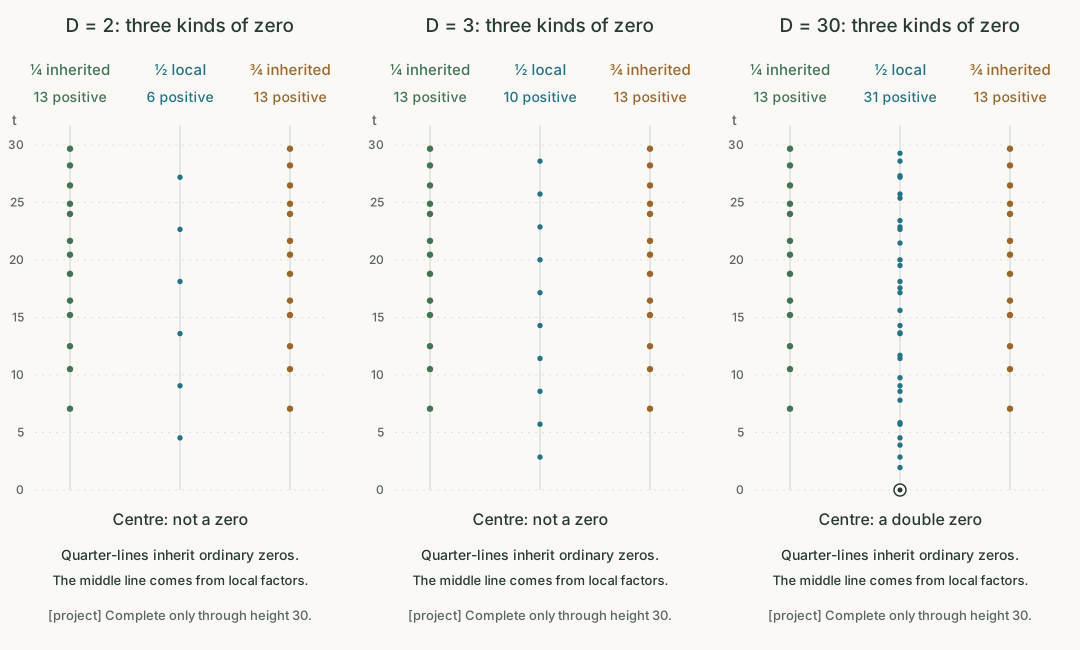
The original height-30 completeness check
[project] First we counted every ordinary-zeta zero through height 60, then transported them by the known exact formula. Thirteen critical-line sign brackets and their negative-height partners exhaust a winding count of 26. Dividing the heights by two supplies both inherited lines. We also wound the order zetas directly: the totals 64, 72 and 116 match the positive roots, their conjugates and the centre. For D = 30, that is 116 = 2 × 57 + 2.
[project] Every whole contour piece, not just its endpoints, was enclosed with interval arithmetic. A 512-bit replay validated 40,702 pieces, including extra subdivisions wherever a coarser image could not exclude zero. Complementary factors were checked nonzero at every inherited and local root, so no unexplained cancellation is hiding in the table. The original height-30 run used the argument principle; the extension above instead uses literal Turing averaging.
What this does not say about RH
[known] The two outside lines are inherited from ζ(2s) and ζ(2s − 1). The middle line comes from elementary ramified-prime factors. Putting all inherited zeros on the quarter-lines, at every height, would be equivalent to ordinary RH. The finite certificate proves that familiar pattern only in this window; it adds no independent information about ordinary ζ. In the reduced-norm coordinate w = 2s, the same lines are ½, 1 and 3/2, and the height-10,000 window becomes height 20,000.
[project] Unlike the independent subfield computation, this run openly uses ordinary ζ and its known factorization. It is a complete finite check of the map, not a new arithmetic L-function, an Artin height-100 result, or RH progress.
Proof, scope and the caught interval pitfall · Counts and certificate manifest · Full interval certificate (gzip, 15.4 MB) · Higher-precision replay result · Replay script · Generator · Voight, Theorem 26.4.9.
Nonmaximal quaternion orders: the Eichler comparison
[known] A quaternion order plays the role, inside a quaternion algebra, that the ordinary integers play inside the rational numbers. Its zeta function counts its ideals, the way ζ counts whole numbers. Near one prime p, the simplest non-maximal kind, an Eichler order of level pr, looks like the 2×2 integer matrices whose lower-left entry is divisible by pr. The bigger r is, the further the order is from the maximal one, and the more its count at p changes. Relative to the maximal-order count, the change is a polynomial correction, whose roots supply local zeros. This is not the whole rational Euler factor. The question is where those extra zeros sit.
[project · our own names] Two kinds of zero. Grant’s names, used only on this site. They are not standard terminology.
- inherited zeros are ordinary ζ zeros, copied at half their usual height onto the ¼ and ¾ lines (if RH holds for ζ). They come in left–right mirror pairs.
- local zeros come from a prime-by-prime correction. For the maximal quaternion orders above, a ramified prime gives the half-line fence with spacing π/log p. Nonmaximal orders have other correction polynomials; the later octonion examples need not put their zeros on ½.
For a definite quaternion order such as the discriminant-30 example, the zeta function factors exactly into stretched copies of ζ times these local corrections, which is why the two families separate cleanly. See the zero lines above.
[project, proved in these notes] For the split local Eichler family, both the invertible-ideal and all-module correction polynomials have all their roots on the circle corresponding to Re s=½. The counting and Chebyshev sign arguments are finite local results; the project’s own referee passes are not outside peer review.
Eichler counting formulas and the two circle proofs
1 · How many invertible ideals there are
[project · proved] [original proof] For every prime p and level r, the number ae of invertible right ideals of reduced norm pe is (e+1)pe when e < r, and [((r+1)p − (r−1))pe − (p+1)pr−1]/(p−1) when e ≥ r. In plain terms: each such ideal is generated by a single matrix, so counting ideals means counting matrices up to the order’s units, and a p-adic volume computation does the count exactly. Packaged as a polynomial in u = p−2s, the local factor is Qrinv(u) = 1 + (p−1)(u + pu2 + … + pr−2ur−1) + prur. Its value at the pole matches Voight’s local mass factor 1 + 1/p, a consistency check. This is careful counting, not a new structural theorem.
2 · Every one of those zeros is on the half-line
[project · proved] [original proof] Every root of Qrinv has |u| = 1/p. Since |u| = p−2·Re s, that is exactly Re s = ½: all of these local zeros sit on the half-line. The idea of the proof is a sign-counting trick. After a change of variable the polynomial becomes a Chebyshev-type curve that is forced to swing from positive to negative r times; each swing crosses zero once, and a degree-r polynomial has only r roots, so every root is accounted for on the circle, and each is simple. A published coefficient test of Lakatos covers only the levels r ≤ p+1, so cases such as p = 2, r = 4 were not already covered there. The argument was checked numerically for r up to 60 and primes up to 50, and re-derived line by line in a referee pass.
Figure 33

3 · Counting all modules, not just invertible ones
[project · proved, refereed] The larger “Solomon” count includes all finite-index right submodules of the regular order (right ideals), not just invertible ones. Its correction has degree 2r in v = p−s; it becomes palindromic after rescaling to w = √p·v. We first guessed a closed form from computed cases; it is now proved for every level r, by counting pairs of columns in a lattice: Qr(v) = Σd,e = 0…r pmin(d,e) vd+e. The coefficients climb 1, 2, p+2, 2(p+1), p2+2p+2, … and then satisfy that weighted mirror rule (part of the proof). The proof passed a separate line-by-line referee pass on the night of 10–11 November 2026. The first four coefficients were also proved one at a time:
- [original proof] Q1 = 2 for every r ≥ 1 (the algebra modulo p has exactly two simple modules, so exactly two maximal right ideals).
- [original proof] Q2 = p+2 for every r ≥ 2 (there are exactly 2p+3 modules of index p2).
- [original proof] Q3 = 2(p+1) for every r ≥ 3 (exactly 4(p+1) modules of index p3; re-derived in the referee pass).
- [original proof] Q4 = p2+2p+2 for every r ≥ 4 (exactly 3p2+6p+5 modules of index p4). Re-checked in the night referee pass by a third, different method (a full four-dimensional Hermite-form brute force at p = 2, 3, 5), in agreement.
[project · proved, refereed] The remaining coefficients and the mirror symmetry follow from the column-pair formula above. [open] A short search found this formula nowhere in the literature; that is weak evidence, and a paper we missed would have priority. A general local functional equation for Gorenstein or Bass quaternion orders is still open.
4 · Those zeros are on the half-line too
[project · proved, refereed] [original proof] Every root of the Solomon factor has |v| = p−1/2, which again means Re s = ½. The proof is the same sign-counting idea with a more elaborate curve: a cosine polynomial of order r is shown to alternate in sign at the 2r+1 angles mπ/(r+1), using four explicit closed values of a geometric-series kernel, so all 2r roots are on the circle and simple. Every inequality stays strict even at p = 2. This sign lemma was first conditional on the guessed closed form; with the closed form now proved, a shorter Chebyshev-polynomial proof gives the circle theorem unconditionally for this split local Eichler family, and that proof also passed the referee pass. At level p3 the zeros were also certified directly, with 512-bit interval enclosures.
Figure 34

[known] None of this is about the Riemann Hypothesis. The half-line results concern finite polynomials attached to one prime; RH concerns the infinitely many zeros of ζ itself, which these local factors do not touch.
4 · Octonion orders: the prime 2 changes the count
Octonions are an eight-dimensional number system, one step past the quaternions. Multiplication is not associative: (ab)c can differ from a(bc). An “order” is a lattice of integer-like octonions closed under multiplication. We counted its ideals, the same kind of count that gives the quaternion-order zetas above, and asked where the zeros of the counting series sit.
[known] For Coxeter’s integral octonions (the E8 lattice), every one-sided ideal is two-sided and of the form mO (Petersson, Integral octonions, 2018 notes, Thm. 1; van der Blij–Springer 1959; Allcock 1999). [project · proved, double-computed] Independently, the left-multiplication matrices generate all of M8(Z). So the ideal-counting zeta is ζ(8s): its zeros are ordinary zeta zeros scaled by 1/8, on Re s = 1/16 only if RH holds. This is an inherited line, not a new one.
[project · proved, computer-assisted, double-computed] For the integer-coordinate (Gravesian) octonions Z8, the count at the prime 2 is Q(x)/(1−x4) with x = 2−s and Q = 1+x+7x2+7x3+14x4+14x5+28x6+8x7+16x8. It satisfies Q(x) = (2x2)4Q(1/(2x)), a reciprocal identity for the numerator, not a self-equation for the full local factor. Four of its zeros lie on Re s = ½ and four off it, at Re s ≈ 1.183 and −0.183 (exact Sturm counts). The period 4 comes from left multiplication by 1+ek, whose square is 2 times a unit. The counts were re-computed on 11 November by separately written code (see the re-count below); that is still the project checking itself, not an outside referee.
[project · proved, computer-assisted] R has full 2-local factor (1+3x²)/(1−x⁴), x=2^(−s). Its numerator has two zeros on Re s=log 3/log 4≈0.7925 and a mirror there. The full local factor has no monomial self-functional equation; neither statement rules out every possible completion. The independent re-count checks all seven R copies.
Every order between Z8 and E8
A short guide. The integer-coordinate octonions Z8 are the smallest natural order. Coxeter’s E8 octonions are the largest; they also allow some coordinates to be halves. In between, you add some “half” elements such as (1+e1+e2+e4)/2 and keep everything closed under multiplication. Each choice gives an order, and each order has its own count of ideals at the prime 2.
[project · computed exactly] There are exactly 16 orders containing Z8: Z8 itself, a single order S1 of index 2 (add ω = (1+e1+…+e7)/2), seven orders of index 4 (the order R above and six copies of it), and seven maximal E8-type orders. Up to symmetry there are only four kinds. The order R turns out to contain ω, so the chain is Z8 ⊂ S1 ⊂ R ⊂ E8, and S1 is the one new case.
[project · proved, computer-assisted, double-computed] For S1 the count at 2 is (1+2x+15x2+35x3+14x4+14x5)/(1−x4), with x = 2−s. Two separate programs (different algorithms, one without PARI) agree up to index 224, for left and right ideals alike, and a bound on the multiplication algebra shows that this range is enough to fix the formula. The numerator has no real-centred reciprocal mirror; an exact gcd test shows that no zero lies on Re s = ½. The five zeros in each period sit at Re s ≈ −0.567, 1.055 and 1.943.
Figure 35

Dual-lattice experiment and independent re-count of all 16 orders
[speculative] We also tried the octonion version of a standard test for “well-behaved” (Gorenstein) orders: is the dual lattice a single multiple S·α? This is the quaternion criterion of Voight, Quaternion Algebras, Lemma 24.2.5. Carrying it over to octonions is our adaptation, not a standard definition. Z8, R and E8 pass and S1 fails. So passing the test does not produce a half-line symmetry here: R passes, yet its zeros avoid ½. In eight dimensions a multiple S·α changes volume by N(α)4, not N(α)2 as for quaternions, and that alone rules out S1.
[project · proved, computer-assisted, independently re-computed] Re-count of all 16 orders (11 November). The morning result checked one order of each kind. A third program, written from scratch for this check and sharing only the multiplication table, found the 16 orders again by a different route (closing Z8 plus half-vectors under multiplication, rather than testing all 309,193 subspaces). It then counted left and right ideals for every one of the 16 orders, not one per kind, up to index 216, building each ideal from a larger one by one simple step. All 32 counts agree with the factors above: S1 gives (1+2x+15x2+35x3+14x4+14x5)/(1−x4), all seven R-type orders give (1+3x2)/(1−x4), and all seven E8-type orders give 1/(1−x8), for left and right ideals alike. A separate PARI computation of the multiplication algebra gives the same bounds as the morning run (2c with c = 2, 1, 0), which is what makes counts up to 216 enough to fix these three factors exactly. Each R-type order sits inside exactly 3 of the 7 E8-type orders, and each of those contains exactly 3 R-type orders. Exact gcd tests again rule out zeros on Re s = ½ for S1 and R. For Z8 itself (c = 3) the new program was run to index 224, the full range its bound requires, and it reproduces Q(x)/(1−x4) exactly, left and right; that answers the “not yet independently re-checked” note above.
Why this matters, plainly: symmetry says the seven R-type orders should behave alike, and so should the seven E8-type orders, so the morning run counted only one of each. This check counts them all with different code, so a mistake in the symmetry argument or in one program would have shown up as a mismatch. None did. It is still the same project's work, not an outside review.
[known] None of this is about the Riemann Hypothesis: these are finite local factors at one prime. Notes: ideal count · period-4 proof · intermediate order · all intermediate orders and the Gorenstein test · independent re-count.
2 is exceptional: what happens at 3, 5 and 7?
[known] All sixteen orders give the same answer at every odd prime. The extra half-coordinates that distinguish them matter at 2, but not at 3, 5 or 7. At an odd prime p, the only right ideals are copies of the whole local order Op scaled by p, p², p³, and so on. Scaling eight coordinates by p gives index p8. So the counting series is a simple geometric series:
[known] Its numerator is 1: no local zeros anywhere, including on Re s = ½. The empty panels below are an exact answer, not zeros we failed to find. The function has poles instead, all on Re s = 0; those are not drawn. The four-on-the-line pattern for the integer-coordinate order G belongs to the prime 2 alone.
Figure 36

[known] Why this is settled, not a guess. Petersson, Norm equivalences and ideals of composition algebras (2021), Theorem 4.1(i), proves that every one-sided ideal of an octonion composition algebra comes from an ideal of its base ring. Over the p-adic integers Zp, those are exactly paZp. Here a right ideal means an additive finite-index lattice L with L·Op ⊆ L. It does not mean an arbitrary set xOp. At odd p our orders are the same nonsingular octonion algebra, so the theorem applies; the non-maximal orders at 2 need separate treatment.
[project, computer-assisted] Checked two ways. A new Fano-table calculation finds 64 products of right-multiplication matrices and verifies explicit formulas for every elementary matrix, using only division by 8. That proves the same answer for every odd prime. A separately coded Cayley–Dickson calculation closes the operator algebra modulo 3, 5 and 7; each gives all 64 matrix directions. Either certificate forces every stable lattice to be a scalar copy. Both give exactly one ideal at indices p0, p8, p16, p24, p32 and none at the intervening powers, with a proof for every index. These are classification-derived counts, not brute-force sweeps over every lattice; no large search at 7 was needed.
[known] Zero-free local factors do not make the continued global zeta zero-free: ζ(8s) itself has these factors and inherits the ordinary zeta zeros. There is no RH claim. Full definitions, published theorem, proofs and caveats · integer certificate · independent modular check · counts A · counts B.
Odd conductor: damage the order at 3, and zeros appear, just not on ½
[project] The odd primes above gave nothing because every order there was maximal: only scaled copies were ideals. So we now make the order imperfect at 3 on purpose. Near 3 the octonions are the split octonions, written as 2×2 Zorn arrays [[a, u], [v, b]]. Keep only those octonions whose remainder mod 3 lies in a chosen smaller algebra: for example the scalars (giving Z₃ + 3O), a quaternion algebra M₂(F₃), or a triangular “Borel-type” piece. Every other prime is unchanged. We count one-sided ideals at 3 exactly as before: lattices L with L·Λ ⊆ L, sized by their additive index.
| Order (what is kept mod 3) | Index in O | Local factor at 3, x = 3−s | Zeros on ½ per period | Real parts of zeros |
|---|---|---|---|---|
| Q · a quaternion M₂(F₃) | 3⁴ | (1 + 4x² + 13x⁴ + 8x⁶ + 17x⁸ + 4x¹⁰ + 12x¹²) / (1 − x⁸) | 0 of 12 | −0.02 to 0.54 |
| P6 · 6-dim parabolic-type | 3² | (1 + 4x²) / (1 − x⁴) | 0 of 2 | all at log 2 / log 3 ≈ 0.631 |
| P5 · 5-dim | 3³ | (1 + 2x + 40x² + 130x³ + 39x⁴ + 39x⁵) / (1 − x⁴) | 0 of 5 | −0.51 to 1.70 |
| N4 · 4-dim, nilpotent part | 3⁴ | degree 8 over (1 − x⁴) | 0 of 8 | −0.63 to 1.43 (four at 0.505 and 0.513) |
| U · Borel-type | 3⁵ | degree 11 over (1 − x⁴) | 0 of 11 | −0.57 to 1.70 |
| Z₃ + 3O · scalars only | 3⁷ | degree 13 over (1 − x⁸), coefficients up to 75,913,222 | 0 of 13 | −1.09 to 4.24 (degenerate) |
[project, double-computed] None of the six orders has a zero on Re s = ½. This is an exact test, not a numerical impression. A zero on the line would be a common root of N(x) and its reflection xdN(1/(3x)), and for every order these two polynomials have no common factor. There is also no mirror symmetry s ↦ c − s. That differs from the quaternion story at odd primes, where every local zero of an Eichler order lies on ½. It also differs from the integer-coordinate octonions at 2, which put 4 of 8 zeros on ½ with an exact mirror. The counts were found twice: by two programs with different octonion models (Zorn and Cayley–Dickson) and different search methods. They agree for all six orders (the second check of the Borel-type order U finished after first publication and matches exactly).
Figure 37

[project, proved] Be careful with Z₃ + 3O: its ideal theory is degenerate. Every lattice squeezed between 9O and 3O counts as an ideal, so the coefficients are subspace counts, as large as 75,913,222. Its zeros, spread from Re s ≈ −1.1 to 4.2, mostly reflect that combinatorics. The diagonal order (keeping a and b) is degenerate in the same way, and we did not finish it.
[project, proved from the local counts] Globally nothing changes at the other primes, so the whole count is ζ(8s) × (1 − 3−8s) × ZΛ,3(s). Its zeros are the inherited zeta zeros, rescaled to Re s = 1/16 if RH is true (no claim), plus these finite local ones. In the explicit formula an odd-prime signal now appears: signed jumps at powers of 3 that the maximal order never had. For the quaternion order these are 8, 20, −136 and 356 at 3², 3⁴, 3⁶ and 3⁸, on top of the usual 8 at 3⁸. They come from the local polynomial, not from the zeta zeros (see which count hears the zeros).
This is groundwork about local factors of octonion orders, members of the wider zeta family; it says nothing about where the Riemann zeta zeros lie.
Definitions, proofs, counts and limits · method A · method B · Z₃ + 3O structural count · polynomials and zeros
The same shapes at p = 5 and 7: still nothing on ½, and the counts follow p
[project, exact test] We built the same damaged orders at p = 5 and p = 7, and two of them also at p = 11, and counted their ideals again with two independent programs. At every prime, no zero of any local factor lies on Re s = ½. The test is exact: it is the same common-factor test as at 3, with the reflection x ↦ 1/(px). There is no mirror symmetry either. The only exception is P6, whose zeros all share one real part, log(p+1)/(2 log p). That is 0.631, 0.557 and 0.534 at p = 3, 5, 7. It moves toward ½ as p grows but can never equal it, because p + 1 ≠ p.
| Order | Local polynomial N(x), x = p−s | Status of the pattern | Checks at p = 5, 7, 11 |
|---|---|---|---|
| U · Borel-type | 1 + 2x + (p³+p²+2p+1)x² + … (11 coefficients) | fitted from 3, 5, 7; now proved for every odd p (see the proofs below) [project, proved] | p = 5: two programs agree p = 7: two programs agree |
| N4 · nilpotent 4-dim | 1 + 2x + (2p²+2p+1)x² + … + 2p³(x⁷+x⁸) | fitted from 3, 5, 7, confirmed at 11; now proved for every odd p (see the proofs below) [project, proved] | p = 5: two programs agree p = 7: two programs agree p = 11: one program so far |
| P5 · 5-dim | 1 + 2x + (p³+p²+p+1)x² + (p⁴+p³+2p²+p+1)x³ + (p³+p²+p)(x⁴+x⁵) | fitted from 3, 5, 7, confirmed at 11; now proved for every odd p (see the proofs below) [project, proved] | p = 5: two programs agree p = 7: two programs agree p = 11: one program so far |
| P6 · 6-dim parabolic | 1 + (p+1)x² | fits 3, 5, 7; now proved for every odd p (see the proofs below) [project, proved] | p = 5: two programs agree p = 7: two programs agree |
| Q · quaternion M₂(Fp) | 1 + (p+1)x² + (p²+p+1)x⁴ + 2(p+1)x⁶ + (p²+2p+2)x⁸ + (p+1)x¹⁰ + p(p+1)x¹² | proved for every odd p (see the proofs below); the p = 7 count matches it [project, proved] | p = 5: two programs agree p = 7: one program so far |
[project conjecture] The counts look like polynomials in p. Each coefficient of the local polynomial is a fixed polynomial in p, and its base-p digits are the same at 5 and 7. For N4 and P5 we fitted these polynomials from p = 3, 5, 7, predicted every coefficient at p = 11, then computed p = 11: all of them matched. That was strong evidence, not a proof; N4 and P5 have since been proved for every odd p (see below). The Borel-type U was fitted from three primes and is now proved for every odd p too (below); the quaternion order at p = 7 had not finished when this was first published; it has since come in with 211 lattices, exactly as the general-p proof below predicts (method A; method B is still running). P6 at p = 7 now has both programs.
Figure 38

[project, exact from the local polynomials] The explicit formula keeps its odd-prime signal. There are new signed jumps at p, p², …. For P6 they are 2(p+1), −2(p+1)² + 4, 2(p+1)³, … at p², p⁴, p⁶. For U, N4 and P5 the first jump, at p itself, is 2 for every prime. The order Zp + pO was not computed beyond p = 3. Its structure theorem holds for every odd p, but the count it needs was only done at 3.
This is about local factors of octonion orders; it says nothing about the Riemann zeta zeros.
Counts, programs, patterns and limits · method A (any p) · method B (any p) · polynomials and zeros · fitted patterns
Every odd prime at once: all five patterns are now proved
[project, proved] Instead of computing one prime at a time, we can now prove two of the patterns for every odd prime p. The idea is simple. Near p an octonion is a 2×2 array [[a, u], [v, b]]. Multiplying by the two corner elements splits every ideal into an “(a, v) half” and a “(u, b) half”. For the orders P6 and Q, which keep both u₁ and v₁ intact, multiplying by u₁ and then by v₁ copies coordinate pairs across and back. So each ideal is pinned down by just two lattices in the plane, tied together by a few simple rules, and lattices in the plane are easy to count: there are exactly p + 1 of index p. The result:
[project, proved] Neither ever has a zero on Re s = ½. For P6 every zero sits at Re s = log(p+1)/(2 log p), which is always a little more than ½, because p + 1 > p. For Q an exact algebraic test (a resultant in p with no prime roots) rules out ½ for every prime, and four of its zeros approach ½ from the right like 1/(4p log p). The formulas agree with every exhaustive computation we have (p = 3, 5, 7), and the proof predicts the still-running Q count at p = 7: 211 lattices.
Figure 39

[project, proved] N4 and P5 are now proved too. Their multiplication only pushes coordinates along chains, so the trick above (copying a pair across and back) is not available. A different idea works. For each of the 8 coordinates, read off two levels: how coarse the ideal gets along that axis (the hull), and how fine you must go before the bare axis vector is inside it (the core). Every ideal is squeezed between these two “boxes”. What is left between them, the glue, records how the coordinates are tied together. Being an ideal then splits into simple inequalities between the levels, which are the same for every prime, plus a rule for the glue. For N4 and P5 the two boxes are never more than one step apart. The glue is then a subspace of a small vector space over the field with p elements, and it must be carried into itself by a few matrices with entries 0 and ±1, again the same for every p. N4 has 256 possible box pairs and P5 has 126. In every one, an exact count gives one of six simple answers, such as p − 1 or (p − 1)²(p² + 5p − 3). Adding them up gives the formulas we had only fitted before:
P5: Zp(s) = (1 + 2x + (p³+p²+p+1)x² + (p⁴+p³+2p²+p+1)x³ + (p³+p²+p)x⁴ + (p³+p²+p)x⁵) / (1 − x⁴).
[project, proved] So neither ever has a zero on Re s = ½, for any odd prime: the same exact resultant test now needs no “if”. For N4 we can also derive, not just measure, how tightly its zeros pinch the line: four zeros sit at Re s = ½ ± 1/(4√2 p1.5 log p) plus smaller terms, two on each side once p is large. (At p = 3 all four are just right of ½; from p = 5 on, at every prime we computed, two are on each side.) The count is computer-assisted, done by exact symbolic code that never uses the value of p. It was checked box by box against the exhaustive searches at p = 3, 5, 7 and 11: 1018, 5146, 16298 and 82714 ideals for N4, all matching.
Figure 40

[project, proved] U is proved too, so all five patterns now hold for every odd prime. 750 of U’s 802 box pairs are counted the same way as N4 and P5. In the other 52, hull and core are two steps apart. The glue then lives in a group built from Z/p², where adding digits can carry, so the field method did not apply directly.
[project, proved] How the last 52 were counted. We first counted the same cells in a look-alike world where p · p = 0 but the digits never carry (polynomials in a symbol t with t² = 0). There the glue is again a subspace over the field with p elements, and the old counter works: each cell holds p(p − 1), p(p − 1)², 2p(p − 1)², p(p − 1)³ or p(p − 1)²(p² + 4p − 4) ideals. Then we showed the carries never matter here. Split the glue into a top layer and a bottom layer, and lift the top using the special “Teichmüller” digits, which multiply without carrying. A check over every case shows that each sum that could carry has at most one nonzero term. So the true count equals the look-alike count for every odd p. All 52 cells match the exhaustive searches at p = 3, 5 and 7, and with them
which is exactly the formula we had fitted. The resultant test then shows that no U zero is ever on Re s = ½, for any odd prime. Its zeros nearest ½ approach from the right like ½ + 1/(2p log p).
Figure 41

These are statements about local factors at one prime; they say nothing about the Riemann zeta zeros.
Proofs, checks and the exact gap · N4 and P5 proof, and what is left for U · reduction code · exact counter · the 256 N4 cells · U’s two-step cells · look-alike count · carry check · machine checks of the proof · check results
Background: why “going up a dimension” proves the Riemann Hypothesis for curves over finite fields, why that proof does not reach ζ, and why octonions block the lift: Lifting a dimension on the Hypothesis page.
Putting the primes together: the four global zetas
[project, proved] The whole count is ordinary zeta, rescaled, with a finite correction at 2. At every odd prime the orders agree. Multiplying those factors by the right factor at 2 gives the four functions below. An ordinary zeta zero ρ becomes an inherited zero at ρ/8: both its real part and its height are divided by eight. So the first checked zero ½ + 14.134725…i becomes 1/16 + 1.766840…i. That is the same zero in a different scale, not a new one.
[known] All four functions have infinitely many inherited zeros on Re s = 1/16. Saying every inherited nontrivial zero is on that line would require RH. The 102 inherited zeros shown below, through height 30, come from the earlier finite certificates and need no RH assumption. The critical reference line for this rescaled zeta family is 1/16, not ½.
| Order kind | Global right-ideal index zeta, x = 2−s | Extra zeros on ½? |
|---|---|---|
| G · integer-coordinate | ζ(8s) QG(x)(1+x4) | Yes · 4 each period |
| S1 | ζ(8s) QS1(x)(1+x4) | No |
| R · each of seven | ζ(8s)(1+3x2)(1+x4) | No |
| E8 · each of seven | ζ(8s), exactly | No |
[project, proved] Multiply before drawing the poles. The odd-prime product is ζ(8s)(1−x8). For G, S1 and R, that last factor cancels the local denominator 1−x4, leaving 1+x4. For E8 it cancels the whole denominator. All four global functions have just one finite pole, at s = 1/8. The non-maximal orders also gain a new zero column on Re s = 0, at s = i(2n+1)π/(4 log 2). Those are zeros of the global correction, not zeros of the original local numerator. The local denominator poles do not survive.
Figure 42
Why ½ becomes 1/16
An ordinary zero ρ appears at s = ρ/8 in zeta(8s). Divide its height by eight too.
λ = 8 · real coordinate = 0.06250 · first height = 1.76684
Static summary. Motion controls appear when JavaScript is available.
Figure 43

[known / project, proved] The full zero description is: every ordinary nontrivial zero ρ divided by eight; the trivial zeros s = −k/4 for k = 1, 2, …; and the correction zeros just described. An exact algebraic gcd test rules out extra correction zeros on Re s = 1/16. Only G has global zeros on ½, from its local factor. At s = 0 there is neither a zero nor a pole: the four values are −96, −81, −4 and −½.
Does each whole function have a mirror?
[known] E8 does. The usual completed zeta function satisfies ξ(w) = ξ(1−w). Set w = 8s: ξ(8s) reflects s ↦ 1/8−s, so its center is 1/16. Explicitly its completion multiplies the raw count by ½(8s)(8s−1)Γ(4s)π−4s. This is the ordinary zeta functional equation with a rescaled input.
[project, proved] The same completion fails for G, S1 and R. Write the finite correction in the table as D(x). Their usual completions are ξ(8s)D(2−s). Each has a zero at s = iπ/(4 log 2), but no zero at its mirror 1/8−iπ/(4 log 2). The notes prove this exactly, using a polynomial gcd and the known zero-free line Re w = 1 for ζ. Multiplying by a nonvanishing exponential conductor factor cannot repair the missing mirror zero. Separately, exact coefficient tests show that none of the three whole correction polynomials has a single reciprocal center of its own.
[project, proved] G’s local numerator still has its mirror about ½. But the inherited zeta center is 1/16 and the new column from 1+x4 is centered at 0: these do not make one global mirror. R’s small numerator reflects about log 3/log 4, not ½; S1’s has no such reflection. For the non-maximal orders, “1/16” names the inherited family’s reference line, not a proved symmetry line of the whole function.
[open] This rules out the usual rescaled-zeta completion, not every imaginable completion. Adding missing mirror factors can manufacture a symmetric function, but introduces extra zeros; dividing out D simply erases the order correction. Neither establishes a new arithmetic functional equation. Proof, zero lists, completion scope and source references · reproducible calculation · transported brackets and exact checks · DLMF completion · DLMF zero facts. No RH progress is claimed.
A mirror pairs zeros. It does not pin them.
[project, proved] G has a local numerator mirror at ½, but that does not force all its zeros onto ½. Four sit on the mirror; four sit off in reflected pairs. R’s numerator has a different mirror, at log 3/log 4 ≈ 0.7925. S1’s has none. The inherited global zeta reference is 1/16, so none of these local numerator mirrors matches it.
Three things must not be confused: the numerator Q(x); the full local factor F2(s) = Q(x)/(1−x4); and the whole global correction D(x) = Q(x)(1+x4), with x = 2−s. A mirror centered at c means s ↦ 2c−s. The extra (1+x4) has its own center at 0; none of the three combined correction polynomials has one reciprocal center.
Figure 44
A mirror pairs zeros; it does not pin them
Watch the pairings appear. The eight plotted roots stay exactly where they are.
Four roots are fixed on ½; four others form two off-line pairs.
Static summary. Motion controls appear when JavaScript is available.
Figure 45

Why exactly four G zeros stay on ½
[project, proved] Put u = x + 1/(2x). Then the exact identity is
[project, proved] On |x| = 1/√2, u is real and lies between −√2 and √2. A rational Sturm calculation proves P has exactly two real roots: one between −5/4 and −1, the other between 0 and 1. Each gives two x-roots on that circle, hence four zeros on Re s = ½. The other two u-roots are complex and give the four off-circle roots. The notes include the short sign table and rational endpoint values. The quaternion Chebyshev argument proved all transformed roots were in its real interval; here that condition fails for two roots. The palindrome itself supplies pairing, not confinement.
A formal mirrored equation exists—but is it a counted order?
[project, proved] A meromorphic “gamma-like” equation is easy to write. Set r(s) = 1/8−s and H(s) = ξ(8s)D(2−s). Then
[project, proved] The ratio has the zeros and poles needed to compensate for the missing mirror partners. It is an exact meromorphic identity, not a nonvanishing conductor factor or a new restriction on zeros. Dividing by D recovers ordinary ξ(8s), removing the order-specific zeros. Multiplying by the reflected D makes a symmetric function, but adds zeros. Neither construction supplies a new arithmetic completion.
[project, proved] The normalized reciprocal polynomial partner fails an arithmetic test. Write D(x) = Σakxk of degree d, and A = 2−1/8. The formal dual D∨(x) = xdD(A/x)/(adAd) has constant term 1 and gives an exact paired equation. But its first counting coefficients would be:
| Kind | Forced coefficient in the normalized formal dual | Problem |
|---|---|---|
| G | Index 2: 21/8/2 | Irrational |
| S1 | Index 2: 21/8 | Irrational |
| R | Index 4: 21/4/3 | Irrational |
[project, proved] Numbers of ideals must be whole numbers. ζ(8s) cannot repair these first coefficients, since its first nonconstant term has index 256. Thus this reciprocal partner is not an additive-index ideal-count zeta of the same finite-correction form. G’s trace-dual lattice (½)G does not help: it is not an order, and its multiplier order is G again. The conductor 2O inside a maximal octonion order has multiplier order O, returning the E8 count if we count ideals for that multiplier order. Counting it as a G-module is a different problem, not the same count; no such module is silently identified with E8 here. The irrational-coefficient obstruction applies to any proposed order or module whose normalized index zeta equals the stated reciprocal partner.
A genuine positive result: the period-four mechanism
[project, proved] The normalizer for G and S1 now has a conceptual proof, not just a computer check. Let Ti mean right multiplication by an imaginary basis unit. Linearized alternativity gives Ti2 = −I and TiTj = −TjTi when i ≠ j. With g = I + Ti, conjugation sends Tj to TiTj. It also preserves the operator algebra for S1, including its extra half-coordinate generator. Thus g normalizes both operator algebras; det g = 16 and g² = 2Ti. Every stable lattice has the chain L ⊃ gL ⊃ 2L, with index steps 24. That explains period four. S1 has the same normalizer but no reciprocal numerator, so periodicity does not force a mirror.
[known / project] Bushnell–Reiner’s 1980 Theorem 2 and remarks, pp. 156–158, were re-read for this comparison. Their Fourier/contragredient argument uses associative orders and a simple associative algebra; it is not an octonion theorem. The earlier proposed Atkin–Lehner extension concerned quaternion orders and remains an argument reading, not a proved extension here. The operator calculation above is direct. [open] A genuinely arithmetic alternative completion outside the stated class, and a conceptual lattice-duality explanation of G’s particular palindrome, remain open. This is not an unrestricted no-completion theorem and says nothing about RH. Full proofs, exact reciprocity table and source comparison · exact checking code · identities and dual coefficients · Bushnell–Reiner record.
Why are octonion orders strange at 2?
Same eight-dimensional space; different rules for what counts as an integer. An octonion order is an integral lattice closed under multiplication. Enlarging the Gravesian lattice G by selected half-coordinate vectors gives S1, R and a maximal Coxeter order O, whose lattice is E8. At an odd prime, 2 is invertible, so those halves make no difference. At 2, they change the multiplication system you see after reducing coefficients modulo 2.
[project, computer-assisted] All four reductions have 256 elements, but they are not the same algebra. G/2G becomes commutative and associative; O/2O remains a noncommutative, nonassociative split Cayley algebra. The middle two have nilpotent two-sided ideals of dimensions 6 and 4. “Split” does not mean degenerate: O’s norm is nonsingular even in characteristic 2. [known / project, proved] All four remain alternative and satisfy the Moufang identities; those division-free identities do not break at 2.
Figure 46

| Kind | Nilpotent ideal N | Quotient by N | Associator span mod 2 | Local numerator zeros on ½ |
|---|---|---|---|---|
| G | dim 7; powers 7 → 4 → 1 → 0 | F2 | dim 0 | 4 of 8 |
| S1 | dim 6; powers 6 → 3 → 0 | F2 × F2 | dim 3 | 0 of 5 |
| R | dim 4; square zero | M2(F2) | dim 4 | 0 of 2 |
| O = E8 | 0 | split Cayley algebra | dim 7 | no local numerator zeros |
Why the collapse happens. For G the norm is q(x)=x02+⋯+x72, with polar matrix 2I. Its polar form vanishes modulo 2, as do its commutators and associators. In fact [project, proved] G/2G ≅ F2[a,b,c]/(a2,b2,c2): its nilpotent ideal is (a,b,c). G is still nonassociative integrally, and its associators reappear modulo 4. The larger half-coordinate lattices repair the polar norm: its ranks modulo 2 are 0,2,4,8, and O has polar determinant 1.
Nilpotent elements are not the same as a nilpotent ideal. Here N means the largest two-sided ideal whose sufficiently long products vanish for every bracketing. O/2O has 64 square-zero elements, including zero, but no nonzero such ideal. Its reduction is a genuine split Cayley algebra, not the degenerate group-algebra reduction of G. In S1 the associator span equals N2; in R it equals N. These are exact finite checks, not a general definition of a radical.
How this reaches the zeta factor—and where it stops. Right ideals in S/2S lift precisely to ideals I with 2S ⊆ I ⊆ S. They see just one layer of the 2-adic ideal tree. At index 32, G has 7 ideals in this layer but 15 in total; S1 has 8 in the layer but 16 in total. Thus the mod-2 counts are neither the full local factor nor its numerator Q. R’s matrix-algebra quotient explains its three codimension-two right ideals; O has no proper nonzero right ideal, agreeing with [known] Petersson’s rank-eight composition-algebra theorem. Higher lifts and the earlier period-four argument are still needed to get QG, QS1 and 1+3x2.
No zero-forcing rule follows from this table. In these four examples only the order with an associative reduction has zeros on Re s=½. The index, nilpotent dimension and associator rank correlate with that one example, but four rows do not prove a general rule. The earlier quartic/Sturm argument explains exactly four G roots on the circle; we have not derived that palindrome from its mod-2 radical. The notes also give two orders with identical mod-2 multiplication but different cyclic index-eight right-ideal lifting data. Nothing here is a claim about RH.
[known; source access stated] Petersson’s Integral octonions, printed pp. 2–3, actually read, explains Coxeter/Bruck’s correction of Kirmse’s lattice and the nonorthogonal half-coordinate construction. Coxeter’s Integral Cayley numbers (1946), pp. 561–578, §4, is cited through that account: the original body was not accessible here. Conway–Smith’s On Quaternions and Octonions, ch. 9, §§9.1–9.3 (pp. 99–105), and §§11.2,11.4 (pp. 135,140), are reading pointers verified in the publisher’s contents, not claims to have read those chapter bodies. Castillo-Ramirez–Elduque, §1, supplies the characteristic-2 Cayley framework; Petersson 2021, Theorem 4.1(i), supplies the one-sided ideal theorem for the nonsingular maximal order. The prime 2 is exceptional for these chosen power-of-2 overlattices, not an assertion that all octonion orders are good at every odd prime.
Full notes, structural proofs, Smith invariants and source-access record · exact tensor and ideal computation · independent full-subspace sieve · structural data · independent verification.
Optional: other ways the construction changes
The main comparison is complete above. These side paths keep the geometric tools, coefficient experiments and earlier examples available without making them prerequisites.
Coefficients that select a direction
Part II · Where the extra directions make a difference
[project] The reduction above describes one very natural extension of zeta. It does not say that all quaternionic or octonionic mathematics is the same as complex analysis. Here are several places where changing the space—or a hypothesis of the formula—really changes what happens.
[known/project] A j-plane is not a separate universe with different axioms: the plane spanned by 1 and j is an ordinary copy of the complex plane. The difference appears when we mix directions or fix coefficients in another plane. If a function’s coefficients pick i, an input involving j need not commute with them. That changes the output for a mathematical reason, not because the axis was renamed.
A sphere really can turn into one point
[project] To break zeta’s directional symmetry, we tried a Dirichlet L-function: a relative of zeta whose terms have repeating weights. Modulo 5, choose weights 1, J, −J, −1, 0, repeating with the residue classes. J is one chosen imaginary direction. Those coefficients are no longer real, so the whole zero sphere need not vanish.
[project · checked] A numerical zero occurs at ½ + 6.18357819545…J. Its residual is 1.70 × 10−65. Keep the same real part and imaginary size, but turn away from J. Perpendicular to J, the function’s size is 1.99211637…. At −J, it is 2.81727798…. It vanishes at just one point of this sphere, in both algebras.
Figure 47

[known/project] Multiplying by the coefficient-conjugate partner using the slice product restores real coefficients and a full zero sphere. This normal function is not generally the pointwise squared norm. The point-versus-sphere distinction is real, but with all coefficients in one complex plane its full angular profile still comes from two ordinary complex values. It is not new arithmetic information.
Turn from i toward j and k
[project · checked] The directional difference is not limited to one example. A second mod-5 zero has height 8.45722917442…. For an order-three mod-7 character, two checked heights are 4.35640162474… and 8.78555471450…. All four numerical examples have real part ½. At each, turning away from the character’s own direction makes a zero into a nonzero value.
[project] Fix the character’s direction as i. The norm depends only on the angle away from i: its constant-norm curves are latitude circles, not usually great circles. But turning around that latitude can change the quaternion’s components while leaving its norm unchanged. At j and k the outputs can have the same size and still be different numbers.
Figure 48

Output ≈ 1.134986 − 0.834308 i + 0.834308 j − 1.134986 k. Norm ≈ 1.992116.
[known/project] “One point per sphere” also needs a qualification: if the character and its conjugate vanish at matching opposite points, the whole sphere can vanish. Our four examples have isolated zeros, but we have not proved that coincidences never occur. For more general quaternionic coefficients, an isolated zero need not point along the chosen coefficient plane.
When a familiar formula changes—or stops being a single answer
[project · checked] Give prime 2 coefficient i and prime 3 coefficient j. At the ordinary real input s = 2, the Euler factors (1 − i/4)−1 and (1 − j/9)−1 do not commute. Reversing them flips the k component from +.025824964… to −.025824964…. The difference has norm .051649928…. Worse, ordinary complete multiplicativity would require the coefficient of 6 to be both ij = k and ji = −k. That rule is inconsistent unless the hypotheses change.
[known/project] This does not break zeta’s own Euler product: at one fixed q, all of its real-coefficient factors lie in the same commuting complex slice. It tells us exactly which assumption prevents order-dependence. An ordered Euler product with noncommuting coefficients is a different construction and must say how it is ordered.
Choose log(−1) = πj: then exp(j log(−1)) = e−π ≈ .043213918….
[project · checked] Both logarithms exponentiate to −1, yet they give different values for the proposed power (−1)j. Without a logarithm branch, that expression is not one uniquely specified number. This is the kind of “some outputs are not valid without extra assumptions” distinction that a casual replacement of i by j misses. The logarithm of a zero value is undefined, whichever direction is chosen.
[known/project] Gamma, sine and positive-base power factors in zeta’s functional equation still commute at one intrinsic input, so that equation extends correctly. At apparent 0 × ∞ expressions, take analytic limits rather than treating the pieces as ordinary finite values. The Mertens inverse integral also survives in Re q > 1 because its factors remain in one slice; moving unrelated quaternionic coefficients across the integral is a different operation. The domain and multiplication convention are part of each theorem.
Folding, linking and a solved collision toy
Square it: a sphere becomes a number
[project] Subtract ½ and square. For any imaginary direction I, (rI)² = −r². A whole critical sphere folds to a single negative real number. Conversely, only points on that critical hyperplane can have a negative real square after subtracting ½.
Figure 49

[known] Xi’s symmetry lets us write ξ(q) = E((q − ½)²), with E an ordinary entire function whose Taylor coefficients are positive. RH is equivalent to every zero of E being negative real. This is exactly the same scalar test in complex, quaternion and octonion space.
[known] The stronger positivity condition is total positivity: all minors of a certain matrix made from those coefficients must be nonnegative, at every size. Ordinary positive coefficients and positive moment matrices are not enough. Jensen and Li criteria also stay real, scalar criteria; there is no new ordering of imaginary numbers hiding here.
[project · checked] Three small coefficient-matrix determinants, at sizes 2, 3 and 4, were 2.2984 × 10⁻⁸, 1.1969 × 10⁻¹² and 4.2326 × 10⁻¹⁷. Positive—but finite spot checks cannot establish an all-orders condition.
The finite sphere: ordinary linking
[known] A round two-dimensional sphere in four-dimensional space leaves room for a loop to link it. The same is true for a round six-dimensional sphere in eight-dimensional space: each has two normal directions, enough for a little circle around it. This is tame linking, not the infinitely nested trapping of a horned sphere. We are talking about these standard round spheres, not arbitrary knotted embeddings.
[project] The catch is on the output side. Nonzero quaternions retract to a 3-sphere, and nonzero octonions to a 7-sphere. Every loop in either of those shrinks away. A value-loop alone therefore has no complex-style winding count. Instead, surround the entire zero sphere with a thin tube and count how its boundary covers the sphere of output directions. That signed covering count is called its degree.
A real zero of multiplicity m contributes m.
[project · proved and checked] The factor 2 comes from two oppositely directed preimages whose orientation signs agree. A direct test with q² + 1 gives two positive preimages of a regular target in both four and eight dimensions. This agrees with established quaternionic degree theory and octonionic multiplicity theory. The notebook gives the derivation; no eight-dimensional mesh certification is being claimed.
[project · correction] Degree counts multiplicity; raw sign changes do not. An even-multiplicity zero does not change a real function’s sign. So RH is not equivalent to “degree equals twice the number of sign changes” unless the multiplicity issue is resolved. Turing’s verification method supplies extra analytic control; a picture of linked spheres is not the whole method.
Watch two spheres collide and leave the critical plane
[project] Here is a fully solved toy, not zeta: Pa(q) = [ (q − ½)² + 1 ]² − a. For positive a near zero, it has two critical spheres of different radii. At a = 0 they merge into one double sphere. For negative a they become two mirror spheres off the critical hyperplane. The total degree stays 4 throughout. Its folded coefficients stay positive throughout, too.
Figure 50
Two critical spheres. Degree 4.
[known] The de Bruijn–Newman deformation gives a real analytic version of zero collisions under a backwards heat equation. Rodgers and Tao proved its threshold Λ is nonnegative. RH is equivalent to Λ = 0. The quaternion and octonion lifts inherit that same scalar threshold, not a new one.
[project · checked] In our earlier two-frequency heat toy, the exact threshold is log(4)/3 = 0.46209812037…. Just below it, one pair is π ± 0.04475865i; just above it, the pair is π ± 0.04468412. Both sides lift to spheres and conserve degree. Neither ordinary degree, the mirror, nor positive coefficients prevents off-plane zeros: this explicit example satisfies all three.
[project · important limit] This heat flow acts within complex slices. It is not ordinary diffusion across four or eight real coordinates. For example, the ambient Laplacian of q² is −4 in quaternion space and −12 in octonion space. Replacing the slice operator by a higher-dimensional Laplacian changes the problem.
What happens to the rest of the toolkit?
| Tool | Quaternion and octonion result |
|---|---|
| Hardy Z and counting | [known/project] A real function of the imaginary radius. Direction adds nothing. Compare full zero counts with critical counts with multiplicity; sign changes alone can miss zeros. |
| Mertens and 1/ζ | [known/project] The same Möbius numbers and the same real M(x). In Re q > 1, the inverse Dirichlet series and Mertens integral work inside each slice. The RH growth criterion is unchanged. |
| Riesz | [known/project] The same entire real-coefficient function. Its RH criterion concerns the positive real ray. It cannot be promoted to a polynomial bound in every direction: R(−x) behaves like −xeˣ. |
| Full Jacobian | [project] Its determinant is |h′|²(B/r)d−2 for h(x+ir)=A+iB. For xi, B vanishes across the whole critical hyperplane—even where xi is nonzero. A vanishing determinant is therefore not a zero locator. |
| Half-angles and spin | [known/speculative] Quaternion rotations do involve half-angles. No established link makes that ½ explain the zeta critical line. Matching symbols is not a theorem. |
[project · checked] As a separate arithmetic sanity check, a 2000-term Möbius inverse sum at 3 + 2.1i lies inside its explicit tail bound of 1.25 × 10⁻⁷. It is the same check in every direction I, not a new source of Möbius cancellation.
The topology at infinity
The horned-sphere question was not finished
[project] A finite zero sphere is round, not horned. But there are infinitely many. Bring infinity into the picture as one extra point, the way a plane becomes a sphere by adding its point at infinity. The zero spheres now shrink toward that point. Every smaller neighborhood of infinity still contains a loop that cannot contract in the zero-set complement. The finite local picture did miss an infinite-scale topological feature.
Figure 51

[project] There is a precise finite count too. The complement of n distinct zero spheres in this rotational configuration has fundamental group Fn: the free group on n loop generators. “Free” means different loops need not commute. For infinitely many locally finite spheres, the group has countably many generators. This is richer than the single sphere’s one basic loop, although it is already encoded by the punctured two-coordinate half-plane.
Why the free-group calculation works
[project] Away from the real axis, write a point as its real coordinate, its positive imaginary radius and its imaginary direction. The complement becomes a punctured upper half-plane times S² or S⁶. Those sphere factors are simply connected. Restoring the real axis does not change loops or disk homotopies, because its codimension is at least three. The punctured half-plane supplies the free group. This argument is for this particular arrangement, not arbitrary knotted spheres.
[project] Another small but real feature: each zero sphere links the compactified real axis once. Its spanning disk crosses the real axis once. Equivalently, remove the axis and that sphere cannot shrink away. Individual trivial-zero points and the pole are not closed loops and do not supply the same kind of linking. A pair of zero spheres in this arrangement is not an ordinary linked pair of circles.
[known/project] Small regular surfaces |ξ| = c around a simple zero sphere are actual tubes, S² × S¹ in quaternion space and S⁶ × S¹ in octonion space. Their finite local geometry is tame. Their global ends can still be complicated. We have not classified all xi level surfaces or proved that their ends contain horn-like interlocking.
[speculative] A good next question is which features of those infinite ends survive beyond the bare zero count, and whether norm-level surfaces add structure that the zero set alone misses. A failure of local simple connectivity at infinity is worth recording; it is not by itself a new RH condition.
A precise answer about the loops at infinity
[project · proved for this arrangement] Move the boundary farther out. The inner holes disappear from view, but there are always more beyond them. Each farther region has a free loop group generated by the zero spheres still outside it. When we include that region back into the earlier one, each surviving loop stays essential. This works in both four and eight real dimensions, without assuming RH.
Figure 52

Why a trivial limit does not mean that the loops go away
[project] The sequence of groups and inclusion maps is an inverse system. Every loop word uses only finitely many named holes, so no one nonempty finite word belongs to every tail: the ordinary inverse limit is trivial. Yet no farther tail maps trivially into an earlier one; there is always another surviving meridian. The end system is therefore not trivial. We single out the end escaping all ambient balls; the complement also has ends approaching individual finite deleted spheres.
[known/project] This is a useful distinction from Alexander’s horned sphere, not proof that we have found one. Our compactified zero set is not even locally connected at infinity. Alexander’s object remains a single topological sphere. Its exterior has nontrivial loops although its first homology is zero. First homology is a simpler test that forgets the order of loops: Alexander’s obstruction disappears under that simplification; our meridian holes do not. The mechanisms differ. See the full end-system proof and Alexander comparison, including the inspected original paper and Alexander duality, Corollary 3.45.
Other octonion constructions: products and lattice counts
Where octonions actually behave differently
[known] Octonions lose associativity: (ab)c need not equal a(bc). Zeta never tests that fault line, because its real coefficients keep each evaluation inside a single complex plane. Even the character experiment uses only a pair of imaginary directions at a time, which still generate an associative subalgebra.
[known · checked example] Use three directions that do not fit in one associative subalgebra. Ghiloni and Perotti’s Remark 3 gives f(w) = we₁ − e₂ and a constant e₄ outside the quaternionic subalgebra generated by e₁ and e₂. Here e₃ = e₁e₂; e₄ is not quaternion k. The slice product is w(e₁e₄) − e₂e₄. Its zero is −e₃, while f’s zero is e₃. Exact arithmetic reproduces the shift: the slice product has size 2 at the old zero, whereas the pointwise product f(w)e₄ is still zero there. Restricting the variable and a constant factor to one quaternionic subalgebra gives the expected associative control.
[project] That is genuinely octonionic behavior. But both points have real part 0 and imaginary size 1. The angle changes; the sphere carrying the zero does not. Even this effect does not force a critical real part.
[known/project] For an octonionic construction using three independent directions, even parentheses become data: (e₁e₂)e₄ = e₇, while e₁(e₂e₄) = −e₇ in our checked convention. Alternativity protects two-generator subalgebras; it does not justify arbitrary regrouping. A meaningful next step is to specify a motivated coefficient system and the order and bracketing of its products before importing any Euler or functional-equation rules.
A three-direction toy: the parentheses move the zero
[project · exact constructed toy] Take three finite Euler-like factors A = 1 − we₁, B = 1 − we₂ and C = 1 − we₄. “Euler-like” describes their shape only: these are not prime coefficients or an arithmetic L-function. Use the star product, which multiplies coefficients before evaluating the polynomial. Then:
A * (B * C) has its zero at −e₁.
Figure 53

[known/project · important correction] For a finite pointwise octonion product, parentheses cannot change the zero set. Norms multiply, so a product is zero exactly when one factor is zero, under either bracketing. These three pointwise factors vanish at −e₁, −e₂ or −e₄. Parentheses change their values at other points, but not that union. The bracket-sensitive zeros above belong specifically to the star polynomial. Confusing those products would manufacture a false effect.
[project] The 431 exact rational checks and recorded results include norm multiplicativity, alternativity, the published example, the associative control and both new roots. This tests a real fault line without pretending that the toy is new arithmetic.
E₈: a real lattice difference, and a different mirror centre
[known/project · exact enumeration] Another route starts with a lattice: a repeating collection of points in eight real coordinates. E₈ is connected with integral octonions, but counting its distances is a distinct problem from evaluating zeta at an octonion. We enumerated its integer and half-integer coordinate points directly. At squared distances 2, 4 and 6, the shell counts are exactly 240, 2160 and 6720.
Figure 54

[known] Define the lattice Epstein zeta by summing |v|−2s over nonzero lattice points v; |v| means distance from the origin. A self-dual lattice is one whose associated reciprocal grid matches the original. With n real coordinates, Poisson summation—the rule exchanging those grids— gives a reflection s ↔ n/2 − s, so the midpoint is n/4. Thus the Gaussian lattice Z² has midpoint ½, the four-coordinate quaternion-integer lattice Z⁴ has midpoint 1, and E₈ has midpoint 2. This is not the quaternion-order ideal-counting zeta discussed earlier.
ΛE₈(s) = π−sΓ(s)ZE₈(s) = ΛE₈(4 − s).
[project · numerical check of known identities] At 80 decimal digits, reflected complex values agree to better than 10−70; an independent theta-integral continuation agrees with the factor formula. At the midpoint the exact continued completed value is −5/6, not zero. The original positive-term series converges only for Re s > 4: the negative central value comes from analytic continuation, not summing positive terms to a negative number.
[known/project · normalization matters] Sum |v|−8u instead and we have simply written s = 4u. The mirror becomes u ↔ 1 − u, with midpoint ½. That change of variable does not put every zero on ½. The two zeta factors would, under RH, give nontrivial-zero families at Re u = ⅛ and ⅞. A mirror’s midpoint and a theorem about where all zeros lie are different claims.
[known/project · sources and reproduction] Viazovska’s E₈ definition and E₄ expansion · Nebe’s classical theta-series exposition · Enumeration and checks · Recorded values · Full derivation and normalization caveats.
Comparison map and the local-coefficient dial
The tiny ways things differ: a map
[known / project] “Quaternion zeta” can mean different constructions. Extra directions, different arithmetic and different multiplication rules do not make the same change. Here are six precise distinctions, with the limits left visible.
Figure 55

| What changes | Where to see it | Essential qualification |
|---|---|---|
| [known / project] Zero directions | Non-real character coefficients | One isolated zero can replace a whole sphere; not for intrinsic zeta. |
| [known / project] Forced central zero | A negative-sign Q₈ Artin function | Quaternionic representation type alone does not choose the sign. |
| [known / project] Bracket-moved roots | An exact octonionic star toy | Not finite pointwise products, and not an arithmetic L-function. |
| [known / project] Extra zero families | Ideal counting in maximal orders | Selected inherited quarter-lines; exact local-factor half-line. The Hurwitz centre is nonzero. |
| [project] Holes at infinity | Complement loops survive arbitrarily far out | Not a proof of a horned sphere or interlocked spheres. |
| [known / project] A different mirror centre | Lattice dimension and the exponent convention | n/4 for |v|−2s: ½, 1, 2 in dimensions 2, 4, 8. Not a universal zero line. |
Do zeros move? Movement, phase and duality
[known] Can a zero of one family move into the other? In one fixed zeta function, nothing moves. Its zeros come from its factors; a shared zero contributes the sum of their multiplicities. Motion only appears when we turn a dial and watch a family of functions. Replacing the local factor by 1 − a·p1−2s slides that prime’s whole local fence sideways, rigidly, to Re s = ½ + log(a)/(2 log p); it reaches the ¼ line at a = p−1/2 and the ¾ line at a = p1/2. Because factors multiply, two zeros that meet simply pass through each other as a double zero; there is no repulsion in this family.
[project] For the discriminant-30 order, no inherited height equals a local height through height 10,000; the closest certified miss there is about 0.0000092. Turning the dial’s angle instead of its size raises the fence one slot per full turn and leaves it unchanged as a set: a relabelling, not a rearrangement. Each fence is also the Fourier “echo” of a comb of prime powers p2k in ideal-index terms, and the merged half-line of the 2, 3 and 5 fences is not random-looking: its gap variance is 0.433, not 1.
Figure 56

[project · reproducible] Invertible count proof · Unit-circle proof · Solomon closed form and Q₁–Q₄ · Solomon sign lemma · Referee pass · All-level Solomon proof · Chebyshev circle proof · Night referee pass · Movement · Phase · Duality · All original-proof tags
5 · What these comparisons mean
Three conclusions, not one universal critical line.
- The intrinsic sphere lift contains the same ordinary zeta information.
- Quaternion and octonion ideal counts have their own local zeros and normalization-dependent inherited lines.
- G’s four half-line zeros are a finite local theorem; the rescaled ordinary zeros do not supply new evidence for RH.
[project] The distinction to keep: rotating a real-coefficient zeta changes its geometric picture, while counting ideals changes the arithmetic function. A change of exponent rescales zero coordinates. A functional-equation midpoint is a mirror, not automatically a line containing every zero.
[speculative] The Artin height-100 and negative-twist tasks mentioned in older sections are now completed for the stated finite examples. Open questions include an arithmetic explanation of G’s particular palindrome, a genuinely motivated alternative completion for nonmaximal octonion orders, and the topology of xi’s norm-level ends. None is a new RH obstruction. Read the current queue and its scope.
[project · reproducible]
Earlier height-50 certificates and maximal quaternion-order formulas
Quaternion Euler products from actual Frobenius elements
All twelve twisted central zeros proved simple
Current research queue and closure gates
Earlier: first certified zeros, infinity, octonion products and E₈
Explicit Q₈ fields, certified mirror signs and actual central values · Sign-certificate script
The small differences, proofs and open questions · New numerical results · New checking script
First research notebook and proofs · Numerical results · Offline checking script · Figure generator
- [known · primary computational data] LMFDB Artin representations 2.2304.8t5.b.a and 2.2304.8t5.a.a: both original records opened and independently checked. PARI 2.17.2 supplies Artin computations; Arb supplies rigorous Bessel-function enclosures for the separate sign certificate. Methods and exact tail proof are in the Q₈ notebook.
- [known · primary] Armitage, Zeta functions with a zero at s = ½ (1972); Fröhlich, Artin-root numbers and normal integral bases for quaternion fields (1972). Original records checked; full scans unavailable. Precise access limits, supporting exposition and a rejected example are in the new notebook.
- [known · primary] Alexander, An example of a simply connected surface bounding a region which is not simply connected (1924); Łojasiewicz, Triangulation of semi-analytic sets (1964). The problem-specific infinity and free-group arguments are written out in the notebook.
- [known · primary] Ghiloni–Perotti, Zeros of regular functions of quaternionic and octonionic variable (2009 preprint): spherical and isolated zeros, the normal function, and the octonionic camshaft example. Full preprint read for this exploration.
- [known · primary] Ghiloni–Perotti, Slice regular functions on real alternative algebras (2011); Gentili–Stoppato–Struppa, Regular Functions of a Quaternionic Variable (2013). Framework references; full texts not freshly read here.
- [known · primary] Eilenberg–Niven, The “fundamental theorem of algebra” for quaternions (1944). The octonionic claims above use the later Ghiloni–Perotti framework, not this paper alone.
- [known · primary] Aissen–Edrei–Schoenberg–Whitney, On the generating functions of totally positive sequences (1951); Turing, Some calculations of the Riemann zeta-function (1953).
- [known · primary] de Bruijn, The roots of trigonometric integrals (1950); Rodgers–Tao, The de Bruijn–Newman constant is non-negative (2018 preprint; published 2020). The latter’s heat-flow normalization was checked directly.
- [known · primary] Riesz, Sur l’hypothèse de Riemann (1916); Littlewood (1912), the Mertens growth criterion. Source-access limits and additional Li/Jensen references are in the notebook.
[project] A longer tangent: what bigger spaces can tell the number line—a sourced ledger of exact downward bridges and analogies that still need one.
[project] Today’s return-map audit: ranked transfer bridges and the all-index Li qualification; which Artin factor owns a zero, and what the bookkeeping cannot exclude; and an independent subfield computation recovering Nζ(30)=3. These are finite checks and exact implication maps, not new RH progress.
Reading path · step 5 of 13